


![Reblog this post [with Zemanta]](https://lh3.googleusercontent.com/blogger_img_proxy/AEn0k_uHt9tqgN9hLcs1nYj8iGhvvi62tsmHFN7u7JXqT-nSH0j-gV_2j5r9ldwEdUrfiGSQdd3kHIqX4CvK35ckIaGhBWTbbudlDN0KWmJoZvoeaeK-3YuVhsfhdjoK7DIlwKMU9rjWUQ9tUKt08SuiFLQ=s0-d)
Showing posts with label search engines. Show all posts
Showing posts with label search engines. Show all posts
Wednesday, June 24, 2009
Gmail to Get More Protection From Snoops - Bits Blog - NYTimes.com
Noting that many power users have already turned on HTTPS protection, Google now says that is considering going further. “Ideally we’d like this to be on by default for all connections, and we’re investigating the trade-offs, since there are some downsides to HTTPS — in some cases it makes certain actions slower,” Ms. Whitten wrote. “We’re planning a trial in which we’ll move small samples of different types of Gmail users to HTTPS to see what their experience is, and whether it affects the performance of their email. Does it load fast enough? Is it responsive enough? Are there particular regions, or networks, or computer setups that do particularly poorly on HTTPS?”
Sphere: Related Content


Saturday, April 19, 2008
Back to the basics
SEO is about maximising your search engine positioning. You can Do It Yourself (DIY) or engage a search engine consultant to do the work for you. To save time, another option is to do it yourself with a little assistance from a consultant.
One of the truisms on the Web is that over half of all webpages are not indexed. There are no links to the pages, or the website. If you have a online business, the website is useless if it does not attract visitors.
The key feature and importance of SEO is to make it easy for search engines to understand your site, page by page. That's SEO in a nutshell.
You SEO the site, page by page, to support the next step: SEM.
SEM is the process of making the website and pages visible to search engines and potential customers.
SEO and SEM are part of website optimization, a part of the overall development of a website for business or community information purposes.
Some companies don't need SEM
Some people think so, anyway.
Companies with very well known brand names don't need to market their site to get visitors. Everyone in Australia will type in 'telstra.com' to find the Telstra website. For almost all of the rest of us, we get to squabble with the search engines to be seen.
Some companies will short the queue, expensively, by buying a place on a list called 'Sponsored Links' using PPC advertising. PPC advertising is popular. These links will be in direct competition with the largest companies in their industries for spots on those lists.
And when the PPC campaign stops, the link -and the visitors- stop.
You see, the largest companies know they do need SEM.
There are three important steps for search engine success.
First, the search engine must know of your site.
Second, because most people using the search engines only look at the first or second SERP (Search Engine Results Page). Using the default settings for Google, that means the first 20 listings. Ever notice how many results you get from a search? It's often in the millions.
Third, if you get a page in the top 20 listing, the person has to see what they're looking for.
Actually, you can break down the numbers a little more.
 If the searcher doesn't see what they're looking for, they'll launch another search.
What if they do find it?
Finding accurate statistics on the behavior of Australians is tough (or expensive.) However, we can get some idea from US statistics (from Coremetrics March 2007)
Take another look.
What those numbers means is people do want to know about the company and the products. They'll go to great lengths to find out, even running the shopping cart and abandoning it to see everything they can.
Those numbers seem to tell us that twice as many people will buy if they find a site in the natural search results as if they type in the name of the site. But that's not the whole story. Three times as many sales and visits came from visitors who typed in the name of the site. That means they've been there before. They know the name of the site.
These are either repeat customers or people who've checked out the company and products.
The time worn adage on the Web is a visitor converts to a customer after 3-5 visits to a website. Guess what? The adage holds pretty well based on those numbers.
The numbers also tell us that about half the visitors won't look past the first page. That starts the old sales numbers game running. To get sales, you have to get visitors.
That note about using site search reminds us to make it easy for the customer to do their job: to buy from you.
And we are back to web design, SEO, and SEM again.
SEO/SEM in Australia is a special issue for so many reasons. Join me was we explore. It will be a fascinating and informative journey. Sphere: Related Content
One of the truisms on the Web is that over half of all webpages are not indexed. There are no links to the pages, or the website. If you have a online business, the website is useless if it does not attract visitors.
The key feature and importance of SEO is to make it easy for search engines to understand your site, page by page. That's SEO in a nutshell.
You SEO the site, page by page, to support the next step: SEM.
SEM is the process of making the website and pages visible to search engines and potential customers.
SEO and SEM are part of website optimization, a part of the overall development of a website for business or community information purposes.
Some companies don't need SEM
Some people think so, anyway.
Companies with very well known brand names don't need to market their site to get visitors. Everyone in Australia will type in 'telstra.com' to find the Telstra website. For almost all of the rest of us, we get to squabble with the search engines to be seen.
Some companies will short the queue, expensively, by buying a place on a list called 'Sponsored Links' using PPC advertising. PPC advertising is popular. These links will be in direct competition with the largest companies in their industries for spots on those lists.
And when the PPC campaign stops, the link -and the visitors- stop.
You see, the largest companies know they do need SEM.
There are three important steps for search engine success.
First, the search engine must know of your site.
Second, because most people using the search engines only look at the first or second SERP (Search Engine Results Page). Using the default settings for Google, that means the first 20 listings. Ever notice how many results you get from a search? It's often in the millions.
Third, if you get a page in the top 20 listing, the person has to see what they're looking for.
Actually, you can break down the numbers a little more.
- 40% of searchers will not look past the top 4 listings; another 20% will look to the rest of the first page. That means over half - 60% - won't even look to the second page;
- another 20% or so will look at the second page. It's about the same breakdown there too. Of this 20% of searchers, only 1 in 5 will look past the middle of the page, or 6 listings, on the second page.
- By the end of that second page, only about 1 searcher in 10 is going to see you.
 If the searcher doesn't see what they're looking for, they'll launch another search.
What if they do find it?
Finding accurate statistics on the behavior of Australians is tough (or expensive.) However, we can get some idea from US statistics (from Coremetrics March 2007)
What is this stuff telling us?
Samples of Coremetrics’ U.S. benchmark data for March include:22.41% of visitors left retail sites after viewing one page, while 51.65% got as far as a product page. Average page views per session was 13.76 and product page views per session 3.78. The average order included 6.12 items totaling $140.10. The shopping cart abandonment rate was 68.42%. 14.84% of consumers used site search during their visits, resulting in a 5.60% conversion rate and an average order of $151.92. 47.89% of traffic and 67.35% of sales came from visitors who typed in the retailer’s URL or clicked on a bookmark. The typical conversion rate on such “direct load” visits was 3.29%. Natural search results accounted for 13.35% of visits and 7.83% of sales, producing a conversion rate of 1.66%. Referrals from sites such as affiliate networks and comparison shopping engines accounted for 5.71% of traffic and 1.97% of sales, producing a conversion rate of 1.36%.
- If a visitor (not a searcher any more, hopefully) finds a retail site, one in five will leave. More than half will look at at least one product page.
- On average, the visitor will look at about 4 times as many product and company information pages than product pages.
- Once the visitor has figured out what they want, they'll buy 6 items. However, almost 70% of visitors will abandon the shopping cart before completing the purchase.
- Visitors that are looking for something in particular (using the site search) will buy more often than those just browsing the website, and spend more money.
- Half of those who came to the site, and 2/3rds (67%) of sales, came from people who typed in the site name.
- Over twice as many visitors came from natural search results (not PPC) as from affiliate or comparison shopping sites. Nearly 6 times as many visitors who found the site from natural search results bought something compared to affiliate links or comparison shopping sites.
Take another look.
What those numbers means is people do want to know about the company and the products. They'll go to great lengths to find out, even running the shopping cart and abandoning it to see everything they can.
Those numbers seem to tell us that twice as many people will buy if they find a site in the natural search results as if they type in the name of the site. But that's not the whole story. Three times as many sales and visits came from visitors who typed in the name of the site. That means they've been there before. They know the name of the site.
These are either repeat customers or people who've checked out the company and products.
The time worn adage on the Web is a visitor converts to a customer after 3-5 visits to a website. Guess what? The adage holds pretty well based on those numbers.
The numbers also tell us that about half the visitors won't look past the first page. That starts the old sales numbers game running. To get sales, you have to get visitors.
That note about using site search reminds us to make it easy for the customer to do their job: to buy from you.
And we are back to web design, SEO, and SEM again.
SEO/SEM in Australia is a special issue for so many reasons. Join me was we explore. It will be a fascinating and informative journey. Sphere: Related Content
Sunday, April 6, 2008
One Keyword per Page
 Image from WikipediaSearch Engine Herald ran an article by Noel titled "SEO Basic - One Keyword per Page" which stuck in my mind for a bit, so I posted the following comment:
The article is on SEO basics. My comments took the subject matter a little further. I just didn't think this short article was being very clear, that's all.What do you mean by ‘optimizing’ when you say one keyword per page?
The LSI process tracks the use of associated terms to interpret the subject of a page. If you define ‘optimization’ as terms within the 2%-15% keyword density (some people target 5%-12%), then the goal of optimization would be to get as many of the commonly associated terms into that range - not just one keyword.
Whichever range is used, getting just one keyword (or phrase) into that range dictates some very short pages. Google once looked at only the first 250-500 words of content in order to build up their index quickly, that’s true. That was a few years ago.The result was many SEO people writing a lot of short pages that resembled intrusive advertising as opposed to truly relevant information.
But Google has changed its perspective recently to favor pages with around 1000-1200 words, which arguably allows for more pertinent information.
Many business websites find it difficult to find 500 words about a category or product, much less 1000, which reflects Google’s long-standing policy to return SERPs which favor information as opposed to sales pitches.
I'd just finished a keyword density analysis on a homepage. There was one word on the page that was within the indicated range. I'd rewritten the page to have 17 words and phrases within the 2-15% range. All but one of the terms clearly pertinent to the topic and the goals of the homepage.
Homepages can be difficult for SEO.
A company may provide a number of services and products that need to be presented along with a brief introduction to convey the attitude and quality of the business.
The Value Proposition of the business is often expressed in a slogan that is not commonly associated with the type of business.
The wider the distribution of services and products, the more the keyword density will be diluted. This is the challenge of SEO and web design.
It's much easier to get the right mix of keyword density for a page on a category of services and/or products; or for a particular service or product. Although finding 250+ words to say about some products can be difficult too.
LSI can actually make writing relevant pages easier, too.
A little research can reveal a number of associated terms on most topics, which means the text can flow more easily and include greater detail without losing relevancy. In fact, using the right combination of terms can make the page more human-readable and more relevant.
Complexity isn't always a negative. Humans are complex. I suppose it could be said the complexity of content has to match as closely as possible the complexity of the target audience.
The complexity offered by LSI and longer pages poses the challenge of writing content that is still scannable. Web users still scan the page. Very few read more than about 55 words or so.
Visitors can be induced to read more of the content by good presentation and interactive content, but that has its limits. A great deal depends on assumptions about the type of traffic the site will draw, and the marketing goals.
Australia
Is it fair to tell a DYI web designer to try to target only one keyword or key phrase per page?
Part of the answer depends on the locale. The article referenced above was written for the US market, where competition is fierce. Content designers in the US market have to contend with a more balanced apportioning of the search engine market.
In Australia, Google with LSI still controls 80% of the search traffic. That's really the basics in this market.
Australian web designers must write for the cutting edge technology, or seek traffic elsewhere. Most Australian sites are designed to be marketed within Australia and New Zealand.; if not regionally within Australia.
SEO/SEM in Australia is a special issue for so many reasons. Join me was we explore. It will be a fascinating and informative journey.

Tuesday, March 25, 2008
Google's Universal Search
This is one I saw coming.
I've been telling clients to get out their webcams and post the video to YouTube to help increase the visibility of their business online. Only a couple of clients took me up on the suggestion. It was hard to overcome the poor Internet connectivity in Australia.
Universal Search
Google's default search will be a Universal Search. The SERPs will include videos, images, news, blogs and web pages. - Everything. It's going to change the SEO/SEM services dramatically.
Universal Search is presently only available in the US. As it spreads across the world, Optimization will include more types of media. The competition for top SERP listings is too competitive to avoid.
You see, really Google is more than a single search engine. In fact, it's many search engines. It's surprising how few people actually use the other search listings. Here's a list:
Each link on the list represents a search engine within Google. Until now, you had to find and use the other search engines. Universal Search, already implemented in the US, will mean all of these search engines will provide SERPs.
If you want just websites and webpages, you'll have to specify that option.
For example, one of the most useful is the Images search. Sometimes, trying to illustrate a website in meaningful ways -something other than pretty girls and other fluff- can be difficult. A quick run through the Images search can give you an idea how others have tackled the problem.
Google News is not comprehensive, but it does provide very recent, relevant information.
For example, I try to stay on top of web developments. I have a weekly email alert on the News search about SEO in Australia.
How will Universal Search affect SEO?
Most websites in Australia are static. The wildfire of SEO services indicates the majority of those sites are not optimized, or even structured. (You gotta wonder what those folks were studying in Web Design classes?)
A few gurus have put out the opinion that for a site to appear high in a Universal Search, the site is going to have to incorporate more universal elements: blogs, images, documents, videos, etc. Naming conventions for these elements will become significant. "img100016.jpg" will be replaced with "black-shoes-look-great.jpg". Because images have their own search engine at Google, it isn't inconceivable that the name of an image could become as significant as a URL.
That presents a problem for a market where business is only beginning to realize the potential of the Web. (Most of my clients are already in the 21st century, I'm happy to say.)
Connectivity still an issue
Some people simply responded: "I can't watch YouTube. Why should I think my customers will?" - And they were right.
Finally, Internet connectivity is improving in Australia. Consumers have become aware of the "Fraudband" -ADSL 256 mbps and below- offerings and ignoring them. Improving does not mean fully implemented. Telstra's rollout of ADSL2 and ADSL2+ is still "aspirational" over the next 9 months. Fraudband is still being sold.
("Aspirational" was Howard's latest way of saying "non-core promises". It's a little like selling opportunity in a multilevel marketing scheme...Howard lost the last election, btw.)
Google may delay the Universal Search rollout for Australia
It may be a good business decision for Google to hold off on providing the Australian market with Universal Search. Large areas of the country, even metropolitan areas, may not have the bandwidth to explore the links.
Google commands nearly 80% of all search traffic in Australia. If a large portion of the Web community cannot click on the SERPs from Universal Search ("USERP"s?), Google could lose its primacy.
The Australian market only represents 1% of the world's Internet population, but it is a rich, competitive and -most importantly- growing market for PPC advertising. Google has only had its regional facilities running for about a year. Yahoo Australia (Yahoo7) offers a much more reliable regional PPC service, and doesn't carry the negative baggage of Google.
The decision for Google will come down to ROI, I imagine. Is the growing Australian market valuable enough not to risk the losses from Universal Search?
Aspirational ADSL
Telstra and other large providers are lowering prices and increasing speeds. Sometimes so quietly you can hardly hear the moss move. Telstra will let customers upgrade to faster speeds free, but the person has to ask for the upgrade. Sometimes the new plan cost less than the fraudband! On the ground, most consumers aren't aware of the situation -yet.
The majority of Australian consumers can now see YouTube videos, use VoIP, and even watch some TV on the Web.
Telstra and Optus are filling TV screens with ads offering a wireless router with ADSL. The "networked home". Great idea. It's been working fine in New Zealand for more than 4 years. Relatively few Australian households enjoy the benefits of a networked home.
(Please forgive the obvious cynicism. It's unavoidable. Australians have been retarded for so long by their government and the large telcos.
A practical run through
Take images as an example. Run a quick search on any topic in Google Images. You'll quickly see that many images were named by software. The name may be from a digital camera, or from the website where the image was purchased.
In the world of Universal Search, that's a missed opportunity. The name of the image may become as powerful an optimization tool as the URL is today. In the Image Search, the name of the image is comparable to the URL of the page; possibly even the page title. It remains to be seen how important to Optimization ALT and TITLE tags will be. Will they be a part of the web page? - or will they be incorporated into the Relevancy calculations for an image?
It's easy to see that ALT tags could become much more important. Those web designers who used the ALT tag to stuff keywords into a document are going have to rethink their (key)words.
Image quality and file size will become more important.
Evenless relevant images will be important for building links. Initially at least, it's not hard to see many sites will fill with images. The practice might come to be called "image bombing", where a site crowds as many images as possible onto its pages to increase its visibility. At least initially, it will improve rankings and conversion rates. How this practice will work out in the long run is yet to be seen.
Hopefully, web designers will press relevant illustrations of business processes; and better product pictures. If not the Web Designers, the SEO people will, I assure you.
Illustrators' Renaissance
Universal Search could drive a renaissance of vector graphics in place of bitmaps. The size of the image file will not just an issue for page download times.
A blotchy image will drive away visitors. Images with good contrast and composition look better in thumbnails appearing next to the link in the search results.
How many web designers have howled into the dark night about having to explain complicated business functions in text, knowing full well that most of the viewers will scan over the page (and never read the well-crafted words)? Good illustrations, animations, and videos that illustrate business processes and services will have a renaissance of sorts. These creative concoctions will have full ranking with web pages and blog articles.
Blogs and Blog articles
Blogs have been the lost hinterland in Australia. Sometimes I think the Outback has a better reputation than blogs.
As it was with Internet access only a few years ago, blog numbers are dominated by large business, national media, universities and TAFEs. Young people are blogging on the social networking sites, of course. Many sites offer free blogging. There are a few blogs set up as ecommerce sites. But few Australians are in the blogosphere.
Citizen journalism here is hindered by restrictive and capricious laws. The concept of slander in Australia is restrictive. It doesn't matter if someone is telling the truth, if the content damages the reputation of the subject, the author is liable for slander.
This is not the United States.
Blogs and blog articles will have to be SEO'd to the same level as web pages under Universal Search. This opens up opportunities for businesses to drive traffic to their websites.
It depends on the editorial policy of the blog, and its goals.
Small and medium sized businesses can demonstrate expertise, build professional reputation, and even have a little fun with blogging. If a blog is too commercial, some blogging sites (e.g., Blogger) will remove access to the blog.
Business blogs can contain anecdotes from Customer service, for example; or outlandish uses for their products; even personal stories about holidays and parties. There is no law that says a business blog has to be all business.
With Universal Search, all these articles will have much more significance.
It's not all that new, really
When you think about it, Universal Search is not a new concept. Google and other search engines have always counted links from YouTube videos, blogs, and their other search engines in the Relevancy calculation. Universal Search is only making that fact obvious.
In doing so, Google is giving those who use the Web community an advantage - and encouraging others to become more community minded. Google is taking a leadership position in defining the relevancy of a website (or blog).
Google's commitment to Relevancy is laudable. My gut reaction is to applaud, in fact. But my head makes me look again at what it may mean to business.
The comments in this article are based on a well-established assumption: That search users will choose from the first 1- 3 or 4-6 of the SERPs. With many new media represented in the SERPs, will that assumption hold true? There will be images, blog articles, and videos mixed in with web pages. Will that cause natural search results to become increasingly irrelevant to business?
If so, will the PPC (Sponsored Links) become far more important and expensive?
Google is taking a leadership role in defining the Web community and Relevance, as it always has. But is Universal Search is a gamble in many ways.
SEO/SEM in Australia is a special issue for so many reasons. Join me was we explore. It will be a fascinating and informative journey. Sphere: Related Content
I've been telling clients to get out their webcams and post the video to YouTube to help increase the visibility of their business online. Only a couple of clients took me up on the suggestion. It was hard to overcome the poor Internet connectivity in Australia.
Universal Search
Google's default search will be a Universal Search. The SERPs will include videos, images, news, blogs and web pages. - Everything. It's going to change the SEO/SEM services dramatically.
Universal Search is presently only available in the US. As it spreads across the world, Optimization will include more types of media. The competition for top SERP listings is too competitive to avoid.
You see, really Google is more than a single search engine. In fact, it's many search engines. It's surprising how few people actually use the other search listings. Here's a list:
- Blog Search
- Book Search
- Catalogs
- Code Search
- Directory
- Finance
- Images
- Local/Maps
- News
- Patent Search
- Product Search
- Scholar
- Video
- Web Search
Each link on the list represents a search engine within Google. Until now, you had to find and use the other search engines. Universal Search, already implemented in the US, will mean all of these search engines will provide SERPs.
If you want just websites and webpages, you'll have to specify that option.
For example, one of the most useful is the Images search. Sometimes, trying to illustrate a website in meaningful ways -something other than pretty girls and other fluff- can be difficult. A quick run through the Images search can give you an idea how others have tackled the problem.
Google News is not comprehensive, but it does provide very recent, relevant information.
For example, I try to stay on top of web developments. I have a weekly email alert on the News search about SEO in Australia.
How will Universal Search affect SEO?
Most websites in Australia are static. The wildfire of SEO services indicates the majority of those sites are not optimized, or even structured. (You gotta wonder what those folks were studying in Web Design classes?)
A few gurus have put out the opinion that for a site to appear high in a Universal Search, the site is going to have to incorporate more universal elements: blogs, images, documents, videos, etc. Naming conventions for these elements will become significant. "img100016.jpg" will be replaced with "black-shoes-look-great.jpg". Because images have their own search engine at Google, it isn't inconceivable that the name of an image could become as significant as a URL.
That presents a problem for a market where business is only beginning to realize the potential of the Web. (Most of my clients are already in the 21st century, I'm happy to say.)
Connectivity still an issue
Some people simply responded: "I can't watch YouTube. Why should I think my customers will?" - And they were right.
Finally, Internet connectivity is improving in Australia. Consumers have become aware of the "Fraudband" -ADSL 256 mbps and below- offerings and ignoring them. Improving does not mean fully implemented. Telstra's rollout of ADSL2 and ADSL2+ is still "aspirational" over the next 9 months. Fraudband is still being sold.
("Aspirational" was Howard's latest way of saying "non-core promises". It's a little like selling opportunity in a multilevel marketing scheme...Howard lost the last election, btw.)
Google may delay the Universal Search rollout for Australia
It may be a good business decision for Google to hold off on providing the Australian market with Universal Search. Large areas of the country, even metropolitan areas, may not have the bandwidth to explore the links.
Google commands nearly 80% of all search traffic in Australia. If a large portion of the Web community cannot click on the SERPs from Universal Search ("USERP"s?), Google could lose its primacy.
The Australian market only represents 1% of the world's Internet population, but it is a rich, competitive and -most importantly- growing market for PPC advertising. Google has only had its regional facilities running for about a year. Yahoo Australia (Yahoo7) offers a much more reliable regional PPC service, and doesn't carry the negative baggage of Google.
The decision for Google will come down to ROI, I imagine. Is the growing Australian market valuable enough not to risk the losses from Universal Search?
Aspirational ADSL
Telstra and other large providers are lowering prices and increasing speeds. Sometimes so quietly you can hardly hear the moss move. Telstra will let customers upgrade to faster speeds free, but the person has to ask for the upgrade. Sometimes the new plan cost less than the fraudband! On the ground, most consumers aren't aware of the situation -yet.
The majority of Australian consumers can now see YouTube videos, use VoIP, and even watch some TV on the Web.
Telstra and Optus are filling TV screens with ads offering a wireless router with ADSL. The "networked home". Great idea. It's been working fine in New Zealand for more than 4 years. Relatively few Australian households enjoy the benefits of a networked home.
(Please forgive the obvious cynicism. It's unavoidable. Australians have been retarded for so long by their government and the large telcos.
A practical run through
Take images as an example. Run a quick search on any topic in Google Images. You'll quickly see that many images were named by software. The name may be from a digital camera, or from the website where the image was purchased.
In the world of Universal Search, that's a missed opportunity. The name of the image may become as powerful an optimization tool as the URL is today. In the Image Search, the name of the image is comparable to the URL of the page; possibly even the page title. It remains to be seen how important to Optimization ALT and TITLE tags will be. Will they be a part of the web page? - or will they be incorporated into the Relevancy calculations for an image?
It's easy to see that ALT tags could become much more important. Those web designers who used the ALT tag to stuff keywords into a document are going have to rethink their (key)words.
Image quality and file size will become more important.
Evenless relevant images will be important for building links. Initially at least, it's not hard to see many sites will fill with images. The practice might come to be called "image bombing", where a site crowds as many images as possible onto its pages to increase its visibility. At least initially, it will improve rankings and conversion rates. How this practice will work out in the long run is yet to be seen.
Hopefully, web designers will press relevant illustrations of business processes; and better product pictures. If not the Web Designers, the SEO people will, I assure you.
Illustrators' Renaissance
Universal Search could drive a renaissance of vector graphics in place of bitmaps. The size of the image file will not just an issue for page download times.
A blotchy image will drive away visitors. Images with good contrast and composition look better in thumbnails appearing next to the link in the search results.
How many web designers have howled into the dark night about having to explain complicated business functions in text, knowing full well that most of the viewers will scan over the page (and never read the well-crafted words)? Good illustrations, animations, and videos that illustrate business processes and services will have a renaissance of sorts. These creative concoctions will have full ranking with web pages and blog articles.
Blogs and Blog articles
Blogs have been the lost hinterland in Australia. Sometimes I think the Outback has a better reputation than blogs.
As it was with Internet access only a few years ago, blog numbers are dominated by large business, national media, universities and TAFEs. Young people are blogging on the social networking sites, of course. Many sites offer free blogging. There are a few blogs set up as ecommerce sites. But few Australians are in the blogosphere.
Citizen journalism here is hindered by restrictive and capricious laws. The concept of slander in Australia is restrictive. It doesn't matter if someone is telling the truth, if the content damages the reputation of the subject, the author is liable for slander.
This is not the United States.
Blogs and blog articles will have to be SEO'd to the same level as web pages under Universal Search. This opens up opportunities for businesses to drive traffic to their websites.
It depends on the editorial policy of the blog, and its goals.
Small and medium sized businesses can demonstrate expertise, build professional reputation, and even have a little fun with blogging. If a blog is too commercial, some blogging sites (e.g., Blogger) will remove access to the blog.
Business blogs can contain anecdotes from Customer service, for example; or outlandish uses for their products; even personal stories about holidays and parties. There is no law that says a business blog has to be all business.
With Universal Search, all these articles will have much more significance.
It's not all that new, really
When you think about it, Universal Search is not a new concept. Google and other search engines have always counted links from YouTube videos, blogs, and their other search engines in the Relevancy calculation. Universal Search is only making that fact obvious.
In doing so, Google is giving those who use the Web community an advantage - and encouraging others to become more community minded. Google is taking a leadership position in defining the relevancy of a website (or blog).
Google's commitment to Relevancy is laudable. My gut reaction is to applaud, in fact. But my head makes me look again at what it may mean to business.
The comments in this article are based on a well-established assumption: That search users will choose from the first 1- 3 or 4-6 of the SERPs. With many new media represented in the SERPs, will that assumption hold true? There will be images, blog articles, and videos mixed in with web pages. Will that cause natural search results to become increasingly irrelevant to business?
If so, will the PPC (Sponsored Links) become far more important and expensive?
Google is taking a leadership role in defining the Web community and Relevance, as it always has. But is Universal Search is a gamble in many ways.
SEO/SEM in Australia is a special issue for so many reasons. Join me was we explore. It will be a fascinating and informative journey. Sphere: Related Content
The 5 Whys
Go to Ask (formerly Ask Jeeves) and type in "Why call a cable installer?"
The first thing you see is the sponsored links. The sponsored links give the following reasons:
Why does someone call a cable installer?
Only one cable installer for every two pages or so. Other than the Sponsored Links, there isn't one cable installer on the first page of results.
It's a good thing Jeeves is retired. Ask doesn't seem to have the answer to "Why call a cable installer?" really. Or do they?
The 5 Why?'s
Like the kid, Customers don't want to hear all the answers to Why. They just want their needs fulfilled. Those Sponsored Links are speaking directly to those needs. In fact, they are saying what marketing research tells them is the most likely reason someone calls a cable installer.
Speak to the Why?'s
(All puns intended.)
The authors of these ads are speaking directly to why the Customers they want will call a cable installer.
But take a closer look at the wording, and consider the targeting.
The top and bottom ad are more likely targeted towards home owners or home business. The mention ADSL, same day service, and a list of home entertainment devices.
The one in the center is targeted for business. It says so clearly. And its terminology is more formal, "installation and maintenance." Home owners install; they don't get an installation. And very few home owners worry about maintenance (unless its their garden or divorce.)
Although there is no reason a business wouldn't want a plasma screen installed or same day service, that's usually not the first consideration. The Customer doesn't have to ask why. They see what they want, click on the ad, and it's instant gratification.
What has happened is the authors of the ad asked themselves Why? a few times. There is an old marketing homily that goes: Ask yourself Why 5 times (to understand your Customer)
The authors asked themselves Why? five times to understand the reasons their Customers wanted the service. If you look at the ads, it works pretty well. They don't talk about experience or qualifications. The text talks about the needs and wants of the Customer.
Web pages
More than likely, 1/2 of those ads are linked to a landing page. Google frowns on landing pages. The landing page speaks directly to the content of the ad. Landing pages are optimized to respond to the ad. The page probably has contact information and a form to book a cable installer. At most, contact information is one click away on another page.
There are small differences in a landing page though. A landing page is not permanent information. It's built just to absorb the production from the ad. One of the main reasons for this is to track the efficiency of the ad. Usually, landing page content is duplicated on the main site.
The landing page may be part of the market research. The company may want to know the effectiveness of different wording for the ad; or whether an image ad is more effective.
If one of the company's main services is cable installation however, there's no need for a landing page. The ad link takes them into the website where a page is optimized for the same Customer needs.
The difference is subtle, but important. If the company does cable installation, the page may not speak as clearly to the Customer's needs from the ad. There may be more information about other Customer needs and wants. Or the page may describe the company more than the need expressed in the ad.
This page will answer the question more fully "Why call a cable installer?", but may not be so clear about answering the Customer's needs. (Unfortunately, neither did whoever took over for Jeeves.)
A very valid question is: Why doesn't this page appear in the search results (SERPs)?
The answer to that is gonna have to be for another time, but try the same search "Why call a cable installer?" on Google or Answers.com. Hint: The reason has a lot to do with Relevancy and tagging.
At the end of the day, "Why call a cable installer?" depends on why you are asking, and who (or what search engine) you ask.
SEO/SEM in Australia is a special issue for so many reasons. Join me was we explore. It will be a fascinating and informative journey. Sphere: Related Content
The first thing you see is the sponsored links. The sponsored links give the following reasons:
- Install Broadband: Same day or its free
- Telephone systems installation and maintenance for all businesses
- TV Installations (7 days): Plasma, LCD, Home theater installs; Flat rate Sydney (and a phone number)
Why does someone call a cable installer?
- Because they want their broadband working for more rooms of their house.
- they want a new phone installed;
- they want their present phones to work better;
- they want a new television or home theater installed.
- Or there is a service broker who wants you to put your job up for cable installers to bid.
Only one cable installer for every two pages or so. Other than the Sponsored Links, there isn't one cable installer on the first page of results.
It's a good thing Jeeves is retired. Ask doesn't seem to have the answer to "Why call a cable installer?" really. Or do they?
The 5 Why?'s
Ever had a little kid see you doing something and ask, "Whatcha doin'?"
You explain, trying to keep your mind on your work, and the kid says, "Why?"
You put aside something, and patiently explain why you're doing what you're doing; and the kid says, "Why?"
About here you're thinking, "I've got to explain this.", and set aside your work completely to give a long winded answer you hope (emphasis needed) will satisfy the kid's curiosity. - And the kid looks at you and says, "Why?"
This time, you're gonna have to reach. Your answer may take in social issues, politics, and maybe even religion. But those soft young eyes meet yours again with "Why?"
This has become a test of wills and character. Most people just tell the kid to go away. Some enlightened types might realize the kid just wants attention. A hug and a tickle satisfy the real reason for all the questions.
Like the kid, Customers don't want to hear all the answers to Why. They just want their needs fulfilled. Those Sponsored Links are speaking directly to those needs. In fact, they are saying what marketing research tells them is the most likely reason someone calls a cable installer.
- One customer may want broadband installed, and today.
- Another might want a telephone system installed.
- Another wants their new plasma TV running, or a home media center connected.
Speak to the Why?'s
(All puns intended.)
The authors of these ads are speaking directly to why the Customers they want will call a cable installer.
But take a closer look at the wording, and consider the targeting.
The top and bottom ad are more likely targeted towards home owners or home business. The mention ADSL, same day service, and a list of home entertainment devices.
The one in the center is targeted for business. It says so clearly. And its terminology is more formal, "installation and maintenance." Home owners install; they don't get an installation. And very few home owners worry about maintenance (unless its their garden or divorce.)
Although there is no reason a business wouldn't want a plasma screen installed or same day service, that's usually not the first consideration. The Customer doesn't have to ask why. They see what they want, click on the ad, and it's instant gratification.
What has happened is the authors of the ad asked themselves Why? a few times. There is an old marketing homily that goes: Ask yourself Why 5 times (to understand your Customer)
The authors asked themselves Why? five times to understand the reasons their Customers wanted the service. If you look at the ads, it works pretty well. They don't talk about experience or qualifications. The text talks about the needs and wants of the Customer.
Web pages
More than likely, 1/2 of those ads are linked to a landing page. Google frowns on landing pages. The landing page speaks directly to the content of the ad. Landing pages are optimized to respond to the ad. The page probably has contact information and a form to book a cable installer. At most, contact information is one click away on another page.
There are small differences in a landing page though. A landing page is not permanent information. It's built just to absorb the production from the ad. One of the main reasons for this is to track the efficiency of the ad. Usually, landing page content is duplicated on the main site.
The landing page may be part of the market research. The company may want to know the effectiveness of different wording for the ad; or whether an image ad is more effective.
If one of the company's main services is cable installation however, there's no need for a landing page. The ad link takes them into the website where a page is optimized for the same Customer needs.
The difference is subtle, but important. If the company does cable installation, the page may not speak as clearly to the Customer's needs from the ad. There may be more information about other Customer needs and wants. Or the page may describe the company more than the need expressed in the ad.
This page will answer the question more fully "Why call a cable installer?", but may not be so clear about answering the Customer's needs. (Unfortunately, neither did whoever took over for Jeeves.)
A very valid question is: Why doesn't this page appear in the search results (SERPs)?
The answer to that is gonna have to be for another time, but try the same search "Why call a cable installer?" on Google or Answers.com. Hint: The reason has a lot to do with Relevancy and tagging.
At the end of the day, "Why call a cable installer?" depends on why you are asking, and who (or what search engine) you ask.
SEO/SEM in Australia is a special issue for so many reasons. Join me was we explore. It will be a fascinating and informative journey. Sphere: Related Content
Thursday, March 20, 2008
Economic Times for SEO
Why does the state of the economy have to do with SEO and SEM? - Everything.
SEO is only the first step towards SEM. Marketers are often compared to guerrilla fighters. "Guerrilla marketing" was a buzzword for marketing online marketing a few years ago.
Mao spoke eloquently and in depth about the role of a guerrilla in society: "The guerrilla in the population is like a fish in a river. If the water is foul, the fish dies. If the water is good for the fish, the fish flourishes."
It's very much the same for marketers. Marketers flourish when the economy is healthy.
Not enough people realize the financial engineering that has created the boom economy in Australia is based on the building industry and real estate market. Most Australians point proudly to the resources boom, but it is just a spike that contributes big numbers. Mining doesn't affect the whole economy anywhere near as much as housing. Mining and resources sales are powerful forces in the regions near the mines.
The resources sector contributes to a healthy balance of payments. One of the indicators of Australia's inflated economy is that the balance of payments is not healthy. The boom has produced an import-driven market where local producers are being priced out of the market. Where is this inflation-driving money coming from?
The long term drought hasn't helped, but market forces could, arguably, have absorbed the drought factor if the import market weren't controlling prices.
Is it a bubble?
The housing boom -government-subsidized building and real estate sales- has created the boom economy. The country has become drunk and addicted to credit. Home ownership is the basis of credit. A home owner can always get a credit card. It's an assumption that homes will always increase in price, and many factors can be quoted to support it.
The family income of the average Australian household is leveraged by credit to 160% (1.6 times the annual income.) That's an average.
On the ground, I know two households who have leveraged their annual income by more than 200% by manipulating credit. Despite all the howling about long hours and job stress, both these couples only worked half a year.
By separating their individual incomes and each working only half a year, they pick up another form of income: government subsidies. One partner applies for broad liberal payments based on their income, easily ignoring the contributions of the other partner. They get even greater leverage by letting the government pay off the credit cards and mortgage.
It's a bubble that has to burst someday. Or does it?
Laberal commentator Ian Martin spelled out the government's attitude before the last federal election. It's an attitude reflected persistently in the press and popular opinion.
There is an Aussie saying: "It's past a joke."
All parties involved seem locked into this scheme, if by nothing else then by the perceptions and attitudes across the country.
There are payments for every stage in life. Most are not means tested. For example, every new mother gets $4000 for giving birth, no matter what the household income.
How does this affect SEO/SEM?
I'll be discussing this issue at length in the next few articles. One factor is that Australia has not experienced a dot-com boom. Most of the country simply didn't have adequate Internet access when the dot-com boom roared through the US, UK, and Europe.
Google wisely only opened offices in Australia two years ago. New amendments to copyright law inordinately influenced by record company activism nearly drove them out in Jan 2007. Google threatened publicly to refuse to index Australian websites. Over 150 exclusions to the law allow a still-tenuous Google presence. Yet Google represents 80% of searches from Australia.
How the changing economic times will affect web design and marketing companies remains to be seen. SEO and SEM may be the means to open the door for Australian small and medium sized business to experience the power of marketing on the Web - to fulfill the lost promise of the web to allow small companies compete in an open market.
The proliferation of SEO companies certainly indicates a need vacuum being filled. It's more a vacuum caused by bad web design and poor access to the Net than an entrepreneurial push though. As online business owners become more savvy, that will change.
I imagine that will be when the SEO companies shake out the chaff, too.
SEO/SEM in Australia is a special issue for so many reasons. Join me was we explore. It will be a fascinating and informative journey. Sphere: Related Content
SEO is only the first step towards SEM. Marketers are often compared to guerrilla fighters. "Guerrilla marketing" was a buzzword for marketing online marketing a few years ago.
Mao spoke eloquently and in depth about the role of a guerrilla in society: "The guerrilla in the population is like a fish in a river. If the water is foul, the fish dies. If the water is good for the fish, the fish flourishes."
It's very much the same for marketers. Marketers flourish when the economy is healthy.
Not enough people realize the financial engineering that has created the boom economy in Australia is based on the building industry and real estate market. Most Australians point proudly to the resources boom, but it is just a spike that contributes big numbers. Mining doesn't affect the whole economy anywhere near as much as housing. Mining and resources sales are powerful forces in the regions near the mines.
The resources sector contributes to a healthy balance of payments. One of the indicators of Australia's inflated economy is that the balance of payments is not healthy. The boom has produced an import-driven market where local producers are being priced out of the market. Where is this inflation-driving money coming from?
The long term drought hasn't helped, but market forces could, arguably, have absorbed the drought factor if the import market weren't controlling prices.
Is it a bubble?
The housing boom -government-subsidized building and real estate sales- has created the boom economy. The country has become drunk and addicted to credit. Home ownership is the basis of credit. A home owner can always get a credit card. It's an assumption that homes will always increase in price, and many factors can be quoted to support it.
The family income of the average Australian household is leveraged by credit to 160% (1.6 times the annual income.) That's an average.
On the ground, I know two households who have leveraged their annual income by more than 200% by manipulating credit. Despite all the howling about long hours and job stress, both these couples only worked half a year.
By separating their individual incomes and each working only half a year, they pick up another form of income: government subsidies. One partner applies for broad liberal payments based on their income, easily ignoring the contributions of the other partner. They get even greater leverage by letting the government pay off the credit cards and mortgage.
It's a bubble that has to burst someday. Or does it?
Laberal commentator Ian Martin spelled out the government's attitude before the last federal election. It's an attitude reflected persistently in the press and popular opinion.
There is an Aussie saying: "It's past a joke."
All parties involved seem locked into this scheme, if by nothing else then by the perceptions and attitudes across the country.
There are payments for every stage in life. Most are not means tested. For example, every new mother gets $4000 for giving birth, no matter what the household income.
How does this affect SEO/SEM?
I'll be discussing this issue at length in the next few articles. One factor is that Australia has not experienced a dot-com boom. Most of the country simply didn't have adequate Internet access when the dot-com boom roared through the US, UK, and Europe.
Google wisely only opened offices in Australia two years ago. New amendments to copyright law inordinately influenced by record company activism nearly drove them out in Jan 2007. Google threatened publicly to refuse to index Australian websites. Over 150 exclusions to the law allow a still-tenuous Google presence. Yet Google represents 80% of searches from Australia.
How the changing economic times will affect web design and marketing companies remains to be seen. SEO and SEM may be the means to open the door for Australian small and medium sized business to experience the power of marketing on the Web - to fulfill the lost promise of the web to allow small companies compete in an open market.
The proliferation of SEO companies certainly indicates a need vacuum being filled. It's more a vacuum caused by bad web design and poor access to the Net than an entrepreneurial push though. As online business owners become more savvy, that will change.
I imagine that will be when the SEO companies shake out the chaff, too.
SEO/SEM in Australia is a special issue for so many reasons. Join me was we explore. It will be a fascinating and informative journey. Sphere: Related Content
Wednesday, September 5, 2007
Success,.. sorta
Just a raw plug for my first SEO clients:I use the excerpt above as part of my signature on this experimental blog to help generate temporal links to Steve's company sites. It's an experiment to see how the rankings are affected.
Short Cut Computers belongs to Steve Trim, a friend who actually paid me to learn this stuff and put it to work for him.
And Steve Trim's other business, Barcode Solutions., which will be my second project.
Steve's main site, Shortcut Computers, had been designed to be easily modified by him and his staff using FrontPage(tm). It had been up for nearly a year when he became interested in what was happening there. -- Nothing.
The site registered about 35 visitors in a year; most of which were probably Steve himself. It was there for him to say he had a website.
After reading a few books on SEO/SEM, we redid the site.
First, it needed to be more dynamic and easier to use. Still experimenting with options, we mistakenly chose PostNuke for the CMS. PostNuke made some things easier, but overall is a programmers' CMS.
Then the overall appearance was reconfigured. The present homepage reflects this step.
It is at least dynamic, but too many of the pages are lost behind long URLs.
Small problems.
During this process, I began researching SEO/SEM.
First step: Wade through a few books.
Second step: Find the resources needed in Australia.
Third step: Apply those resources to accomplish the goals of the business.
I began "internet marketing" back when AltaVista and Lycos were the search engine paradigms. Google and Yahoo in those days didn't exist. The key to internet marketing was, and still is, LINKS!
Step two was an eye-opener. There simply weren't that many directories and search engines. Two industries, tourism and mining, were well represented. Business listings were made on government or telecom sites. The Yellow Pages in Australia had spawned three different access sites; all of whom charged for listings.
Step three was the real challenge though.
The small company's service area was a number of suburbs on the southeast side of Melbourne. Although this area comprised over 1 million residents, it sat on the bleeding edge of broadband availability. Most of his customers were condemned to dial up Internet access.
(Click the 'Melbourne' tab on the iBurst availability map. There are other similar maps - and more timely - but this one tracks very closely and illustrate the point. Then enter 'Dandenong' to see the availability in the company's service area.)
This company, like 90% of small business in Australia, didn't want to market nationally or even citywide.
Links from search engines were good for natural rankings -- "roamers" in SEM-speak -- but to increase business, we needed visitors -- "convertibles" SEM-speak -- who could take use the services. For that, we needed to target a region not commonly defined: PPC advertising.
For Melbournians, the "southeast suburbs" is easily understood. For Google-Aus and Yahoo7, it means nothing.
We established a blog for the company to demonstrate expertise in depth, and to keep up with changes in the business climate of the service area. Fortunately, the changes came fast and furious in the media. Rupert Murdoch announced on a visit that "Internet service in Australia is abysmal." Optus went public with plans to form G-9, excluding Telstra. Then the bubble-heads in Parliament passed archaic copyright law amendments.
Nothing drives Internet traffic like other media.
Avoiding any more of the details, we managed to get 70-90 visitors per day to the site within 3 months. Page ranks from Google (2), and Alexa(about 260,000) gained over 6 months or so. The site rose quickly to SERP positions 1-4 in most of the service area. The blog is cited regularly on other blogs. We even saw visits on the blog from Canberra.
While I was away in Hawaii, things were neglected. The number of visitors held pretty solid because of the natural search. PPC campaigns were abandoned though, and 'convertibles' waned.
Overall, a success. With the caveat that it can only improve with more attention
What was found and learned about SEO/SEM in Australia was to be applied to another of Steve's enterprises: Barcode Solutions. This has to be easier. Its market is national and international. (Hope springs eternal. It wasn't...) Sphere: Related Content
Latest figures just like the first...
Hitwise reiterates the search figures for Australia. These numbers seem to hardly change.
Yes, Google-Aus and Google dominate the search engine traffic with more than 84%. (Google-Aus: 68.45%, Google: 14.81%). If anything, Google has increased its dominance in the last year.
Yahoo7 (Yahoo-Aus and TV channel 7) are really pulling out all the stops to try to gain more interest in their offerings, but for the highly profitable SERP numbers (Yahoo-Aus: 3.03%); they've only managed to fall behind their pricey competitors at NineMSN (8.20%).
For anyone looking to market a website to Australia, Google is pretty much the whole ball game - Or is it?
The sophistication of Google's search algorithm is lost in the shallow Australian market (more on this later), but the power of being the icon of Internet search is overwhelming to the raw Australian user. Ever heard anyone say: "I Yahoo'd it."?
MSN has taken the perspective of becoming the high priced spread to maximize profits from its marginal position. Makes sense. This is really Microsoft, after all.
I don't hate Microsoft. They've made too many smart moves not to respect them. I just wish more people would learn about Linux, and make the whole software marketplace more reasonable.
But pricing an ad on MSN at $20,000 a month is ridiculous in Australia. It limits MSN to only big business in a country where 96.4% of registered businesses are small (under $2M gross with less than 5 employees, as defined by the Finance Minister.)
Lead by an Internet-phobic government, you have to wonder when the Australian public will suss this stuff out. The entrepreneurial search engine industry is already beginning to diminish. No one knows how to interpret the regressive copyright laws, and that has scared many out of the market.
Even some university projects have changed their focus from setting up a search engine to producing the software.
Just a raw plug for some SEO/SEM clients:
Short Cut Computers belongs to Steve Trim, a friend who actually paid me to learn this stuff and put it to work for him.
And Steve Trim's other business, Barcode Solutions., which will be my second project. Sphere: Related Content
Yes, Google-Aus and Google dominate the search engine traffic with more than 84%. (Google-Aus: 68.45%, Google: 14.81%). If anything, Google has increased its dominance in the last year.
Yahoo7 (Yahoo-Aus and TV channel 7) are really pulling out all the stops to try to gain more interest in their offerings, but for the highly profitable SERP numbers (Yahoo-Aus: 3.03%); they've only managed to fall behind their pricey competitors at NineMSN (8.20%).
For anyone looking to market a website to Australia, Google is pretty much the whole ball game - Or is it?
The sophistication of Google's search algorithm is lost in the shallow Australian market (more on this later), but the power of being the icon of Internet search is overwhelming to the raw Australian user. Ever heard anyone say: "I Yahoo'd it."?
MSN has taken the perspective of becoming the high priced spread to maximize profits from its marginal position. Makes sense. This is really Microsoft, after all.
I don't hate Microsoft. They've made too many smart moves not to respect them. I just wish more people would learn about Linux, and make the whole software marketplace more reasonable.
But pricing an ad on MSN at $20,000 a month is ridiculous in Australia. It limits MSN to only big business in a country where 96.4% of registered businesses are small (under $2M gross with less than 5 employees, as defined by the Finance Minister.)
Lead by an Internet-phobic government, you have to wonder when the Australian public will suss this stuff out. The entrepreneurial search engine industry is already beginning to diminish. No one knows how to interpret the regressive copyright laws, and that has scared many out of the market.
Even some university projects have changed their focus from setting up a search engine to producing the software.
Just a raw plug for some SEO/SEM clients:
Short Cut Computers belongs to Steve Trim, a friend who actually paid me to learn this stuff and put it to work for him.
And Steve Trim's other business, Barcode Solutions., which will be my second project. Sphere: Related Content
Thursday, November 30, 2006
Fresh SEM in OZ
Fresh SEM in Oz
by Paul Donley
When I started looking into SEO and SEM, I roamed the Net a little to see what the buzz was all about, then - after realizing that I was lost in acronyms and neologisms again - checked out a couple of books from my online reference library and settled down in front of the computer with a strong cup of coffee for some reading.
It didn't take a long time before I realized that I was looking at some grreeeat stuff -- but it didn't pertain to the Land of OZ.
Fresh in Oz
Australia took to the Internet faster, person by person (per capita), than any other country in the world. In 2000-2001, fewer than 10% of Australian households had access to the Net. Last year, 2005, 35% of all Australian households had access; and slightly more, 41%, of Australian businesses - mostly small businesses.
Of those, 65% were using broadband access of one form or the other.
It's been predicted in 2010 that 70% of small businesses in Australia will be on the Net. The Internet will be the most important advertising resource for small business. And Australia has a lot of small, regional and local businesses.
Googled
At this point, however, Australia is new to the Net - and computers.
There have already been a few marketing surges as Australians moved first to replace their older P1 and P2 systems with P4's in order to run XP, then Celeron made a splash, and the next surge is already underway with the dual-core hardware. Households no longer have just one computer. There is usually a desktop and a couple of laptops in most households these days.
All those new computers need access to the Internet, so .. wireless networking is popular. For most households, the first network they'll see will be wireless - at the home or office.
But all this hardware doesn't mean everyone has instantly acquired computer skills. Far from it.
Driven by their children, who see the latest hardware and software in the schools - because both Victoria and NSW are constantly upgrading the school to fulfill campaign promises - households have spent thousands over the past 5 years to acquire computers that no one seems to really know what to do with.
Even the teachers who are running around with those hot new laptops are a little confused. But they sure look impressive!
Let me use the major search engines to illustrate what I mean.
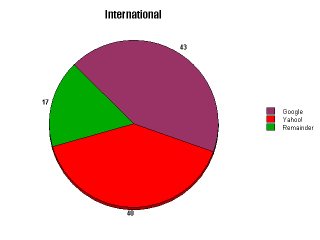
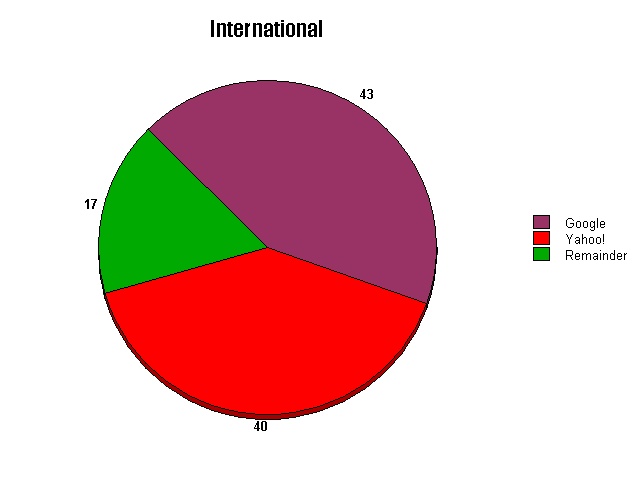
Internationally, Google and Yahoo are neck and neck when it comes to searches. The last figures I saw put Google at 40% and Yahoo! at 43% of all searches. Google, because its name has become synonymous with "search on the Net"; and Yahoo! because they are the best established portal to the Net.
The International figures look something like this. (I made this chart using an online service for school children called Create a Graph from the National Institute for Educational Statistics. It's a free online service.)
Australia is a little different. Since the aussies are new to the Net, they're more susceptible to the buzzwords. They "google" for things.
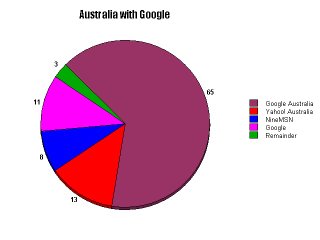
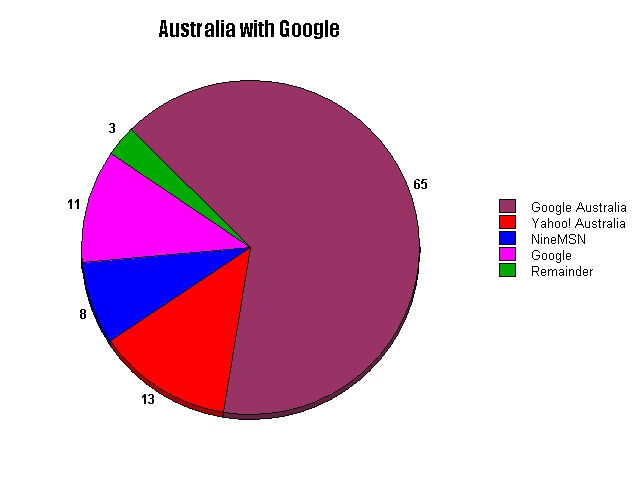
While Yahoo! and Google pretty much split the International pie; in Australia, Google-Australia has 65% of the searches.
Since the aussies are new kids on the block, many don't realize there is a Google-Australia. About 13% use the original Google site. -- In Australia, Google commands nearly 80% of all online searches.
That is a commanding position.
If, for example, I want to build Internet presence and recognition for a website - based on keywords - by putting their services before 70% of the web, all I need is Google. They command nearly 80%. I can accomplish my goal easily with a Google PPC (point per click) campaign.
Aussies suss it out
As the aussies suss out the Internet, that will change.
Australians follow the trends from America, especially on the Net. It's reasonable to assume that they'll be moving more towards the International market split for searches soon.
Local Directories
Australian governments have spent to provide every large town and region with its own Community Guide - a local directory of business and events. Even local townships and suburbs have their own Community Guides.
Telstra (with vast government subsidies) has developed the Yellow and White pages, then linked both to a national advertising campaign for Sensis.
There are also a number of entrepreneurial search engines and directories that have sprung up.
Although all this activity will not supplant the dominance of Google Australia and Yahoo! Australia, it will serve to nudge the aussies along to suss out the way to search the Net.
Aussies are pretty clewy.
eBay is going to help, too, over the Christmas shopping season. Australians go to eBay for things almost as much as they do to the search engines. A shopper can have a bit of fun with eBay. If they find something on eBay, but want to see the (approximate) price in Australian dollars, all they have to do is add ".au" to the URL - and the price in Australian dollars appears!
How long is it??
This long!
Aussies are moving fast on the Net. But the question for any Internet Marketing campaign is: How long will it be before they are searching like the rest of the world?
A number of factors come into play here quickly. Aussies are notoriously brand loyal. It takes a tsunami or a good hit of dynamite to make them move from something. Then again, there is that pressure to be like the US and UK, which sorta balances it all out.
We can have a bit of a play with another figure, the loyalty numbers, and fuzzy logic to make a good guess.
Google commands a 74% loyalty. Yahoo! gets only about 47%. Neither bad numbers really.
And remember, MSN already has 13% of the searches within Australia through its affiliation with NineMSN.
Let's see what happens to Google.
We start with 65% - the portion of searches Google had in 2005 - and estimate their portion in 2006 to be 74% of 65%, or -- 48%. That leaves a bigger slice of the pie for Yahoo! Australia and NineMSN, along with all those local and regional directories.
If people know what kind of business or service they want, they will learn to turn to local directories because it's quicker. Aussies are very community minded.
Now, if you assume that the searches done on Google US are gonna stay about the same because those folks are looking for something outside Australia, then Google will enjoy about a (48 + 13) 61% share of the searches in 2006. (I gotta wonder how close I'm gonna be. The figures will be out soon.)
Do the same thing for 2007, and the number doesn't track. 74% of 48 plus 13 is .. 35 percent. In order to track with the 2005 International figures, Google will have to pick up a few from somewhere - probably Yahoo!, which can only keep the loyalty of less than half (47%) of its searches.
But the guesstimate still works. It'll take the aussies about two years to suss out the search options on the Net, which sounds about right.
By the end of 2007, aussies will be searching along like the rest of the world.
Where the community directories and entrepreneurs will come into the mix, we'll have to look into in another article.
If the stuff in this blog makes sense to you, visit my website at AEmeritus Relevant Training
because that's where it's all gonna be put in motion.
Just a raw plug for my first SEO clients:
Short Cut Computers belongs to Steve Trim, a friend who actually paid me to learn this stuff and put it to work for him.
And Steve Trim's other business, Barcode Solutions., which will be my second project. Sphere: Related Content
by Paul Donley
When I started looking into SEO and SEM, I roamed the Net a little to see what the buzz was all about, then - after realizing that I was lost in acronyms and neologisms again - checked out a couple of books from my online reference library and settled down in front of the computer with a strong cup of coffee for some reading.
It didn't take a long time before I realized that I was looking at some grreeeat stuff -- but it didn't pertain to the Land of OZ.
Fresh in Oz
Australia took to the Internet faster, person by person (per capita), than any other country in the world. In 2000-2001, fewer than 10% of Australian households had access to the Net. Last year, 2005, 35% of all Australian households had access; and slightly more, 41%, of Australian businesses - mostly small businesses.
Of those, 65% were using broadband access of one form or the other.
It's been predicted in 2010 that 70% of small businesses in Australia will be on the Net. The Internet will be the most important advertising resource for small business. And Australia has a lot of small, regional and local businesses.
Googled
At this point, however, Australia is new to the Net - and computers.
There have already been a few marketing surges as Australians moved first to replace their older P1 and P2 systems with P4's in order to run XP, then Celeron made a splash, and the next surge is already underway with the dual-core hardware. Households no longer have just one computer. There is usually a desktop and a couple of laptops in most households these days.
All those new computers need access to the Internet, so .. wireless networking is popular. For most households, the first network they'll see will be wireless - at the home or office.
But all this hardware doesn't mean everyone has instantly acquired computer skills. Far from it.
Driven by their children, who see the latest hardware and software in the schools - because both Victoria and NSW are constantly upgrading the school to fulfill campaign promises - households have spent thousands over the past 5 years to acquire computers that no one seems to really know what to do with.
Even the teachers who are running around with those hot new laptops are a little confused. But they sure look impressive!
Let me use the major search engines to illustrate what I mean.
Internationally, Google and Yahoo are neck and neck when it comes to searches. The last figures I saw put Google at 40% and Yahoo! at 43% of all searches. Google, because its name has become synonymous with "search on the Net"; and Yahoo! because they are the best established portal to the Net.
The International figures look something like this. (I made this chart using an online service for school children called Create a Graph from the National Institute for Educational Statistics. It's a free online service.)
Australia is a little different. Since the aussies are new to the Net, they're more susceptible to the buzzwords. They "google" for things.
While Yahoo! and Google pretty much split the International pie; in Australia, Google-Australia has 65% of the searches.
Since the aussies are new kids on the block, many don't realize there is a Google-Australia. About 13% use the original Google site. -- In Australia, Google commands nearly 80% of all online searches.
That is a commanding position.
If, for example, I want to build Internet presence and recognition for a website - based on keywords - by putting their services before 70% of the web, all I need is Google. They command nearly 80%. I can accomplish my goal easily with a Google PPC (point per click) campaign.
Aussies suss it out
As the aussies suss out the Internet, that will change.
Australians follow the trends from America, especially on the Net. It's reasonable to assume that they'll be moving more towards the International market split for searches soon.
Local Directories
Australian governments have spent to provide every large town and region with its own Community Guide - a local directory of business and events. Even local townships and suburbs have their own Community Guides.
Telstra (with vast government subsidies) has developed the Yellow and White pages, then linked both to a national advertising campaign for Sensis.
There are also a number of entrepreneurial search engines and directories that have sprung up.
Although all this activity will not supplant the dominance of Google Australia and Yahoo! Australia, it will serve to nudge the aussies along to suss out the way to search the Net.
Aussies are pretty clewy.
eBay is going to help, too, over the Christmas shopping season. Australians go to eBay for things almost as much as they do to the search engines. A shopper can have a bit of fun with eBay. If they find something on eBay, but want to see the (approximate) price in Australian dollars, all they have to do is add ".au" to the URL - and the price in Australian dollars appears!
How long is it??
This long!
Aussies are moving fast on the Net. But the question for any Internet Marketing campaign is: How long will it be before they are searching like the rest of the world?
A number of factors come into play here quickly. Aussies are notoriously brand loyal. It takes a tsunami or a good hit of dynamite to make them move from something. Then again, there is that pressure to be like the US and UK, which sorta balances it all out.
We can have a bit of a play with another figure, the loyalty numbers, and fuzzy logic to make a good guess.
Google commands a 74% loyalty. Yahoo! gets only about 47%. Neither bad numbers really.
And remember, MSN already has 13% of the searches within Australia through its affiliation with NineMSN.
Let's see what happens to Google.
We start with 65% - the portion of searches Google had in 2005 - and estimate their portion in 2006 to be 74% of 65%, or -- 48%. That leaves a bigger slice of the pie for Yahoo! Australia and NineMSN, along with all those local and regional directories.
If people know what kind of business or service they want, they will learn to turn to local directories because it's quicker. Aussies are very community minded.
Now, if you assume that the searches done on Google US are gonna stay about the same because those folks are looking for something outside Australia, then Google will enjoy about a (48 + 13) 61% share of the searches in 2006. (I gotta wonder how close I'm gonna be. The figures will be out soon.)
Do the same thing for 2007, and the number doesn't track. 74% of 48 plus 13 is .. 35 percent. In order to track with the 2005 International figures, Google will have to pick up a few from somewhere - probably Yahoo!, which can only keep the loyalty of less than half (47%) of its searches.
But the guesstimate still works. It'll take the aussies about two years to suss out the search options on the Net, which sounds about right.
By the end of 2007, aussies will be searching along like the rest of the world.
Where the community directories and entrepreneurs will come into the mix, we'll have to look into in another article.
If the stuff in this blog makes sense to you, visit my website at AEmeritus Relevant Training
because that's where it's all gonna be put in motion.
Just a raw plug for my first SEO clients:
Short Cut Computers belongs to Steve Trim, a friend who actually paid me to learn this stuff and put it to work for him.
And Steve Trim's other business, Barcode Solutions., which will be my second project. Sphere: Related Content
Subscribe to:
Posts (Atom)