Showing posts with label seo sem. Show all posts

Wednesday, April 2, 2008

Why some businesses stay small

Hogan’s Heroes (book cover)Image from WikipediaHogan's Heroes is still popular in Australia. Frequently in off-prime time advertising, you'll see commercials for DVD sets of past episodes. It's been the same ad for more than 5 years. Must be doing pretty well still.
Hogan looks around the room. "Look. I came up with the idea to steal it, right? -- Well, the rest is just detail." - He could be talking about parking a Tiger tank behind the barracks...
Bob Crane's (Hogan) wife was Col. Klink's secretary in the series. You can almost hear her say, "He's just like my brother. He has all sorts of great ideas."

Dr. Greg Chapman PhD, business coach and university lecture -also a Telstra Business Awards judge- , has authored a new book about Australian small business "The Five Pillars of Guaranteed Business Success.
AUSTRALIAN small business, in many respects, is recognised as the backbone of the economy. According to government statistics, there are more than 1.88 million small businesses, employing 3.6 million people. Their combined capitalised worth is $4.3 trillion -- more than four times that of the Australian Securities Exchange. (The Australian)
Dr Chapman's book and Col. Klink's secretary are talking about the same things.

SEO and SEM is a part of the expansion of a business. Even successfully applying a few techniques can put pressure on a business that it may not be prepared for.

Why do small businesses stay small?
My first reaction is deterministic: They choose to stay small. One way or the other, it's a choice made by the owner(s) of the company.

Some businesses choose to stay small consciously in order to be more involved in projects and to offer better service and response to their customers. There's a sort of critical mass here. The profits must be enough for the business to survive and prosper. That means the business has an established reputation within a region or profession. If either of these factors is missing, then the choice to stay small is only going to lead to the business closing.

In some cases, there may be no choice. The business must stay small because of limited resources. The qualifications of the owner are the reason the business works. Or the business may be based on some legally or physically limited natural resource, such as water. The business is defined by the resource, not the market, and that sustains profits.
Expansion means stretching those resources or lowering standards. If the business is based on the owner's qualifications, even adding a second truck could mean those standards will not be maintained. To expand means making compromises the owner is not willing to make.

Planning
As Dr Chapman points out, most businesses fail because of planning - or more correctly, the lack of it.
If you ask most small business owners though, they will cite financial reasons. At a given point in the growth of a business, this may be a valid reason.
Most often though, that point has been reached because of a lack of planning and good financial management. Few small business owners are skilled at maximizing the value of their assets, receivables and cash flow.
On the ground, too often the business is financed using credit cards. Small business owners will say over and over, "You have to spend money to make money." - not to explain why they've invested in marketing or financial planning, but as an excuse for why the company has not grown. The saying is followed by: "And I don't have the money!"

Two ways of saying the same thing: "90% of businesses don't have a plan. 90% of businesses that have a plan succeed." and "Only 2% of small businesses have a plan for their business."
Which brings us to..

Goals
Planning for a small business is critical. But not grandiose. It's incremental:
  • Set goals,
  • Take a step,
  • Evaluate it,
  • Then based on the results look to the next step.
Too often small business invests in a new project because someone told them it was a good idea, or they feel pressured by recent circumstances. The volume of business grows, so they add a new truck. When the momentary volume falls off, the business is stuck with a new -now non-producing- expense. There was no Goal, and the business is forced into the Evaluation phase. The only evaluation is less money.
The business is forced into the cycle of Planning without any Plan to work with. The business capacity has expanded, but there is nowhere to use it - until another rush of business.

Establishing an online presence by applying SEO/SEM can be one of those steps. Within a Plan, SEO can help a business accomplish its goals. Without a Plan, the business may see SEO as just another expense, and abandon the effort before it bears fruit.
One of the keys is to have some means to evaluate the success or failure of SEO. Most of the time, that means placement in the SERPs.
When a reputable SEO Specialist tells the owner that they can't guarantee placement in a week or a month - that's all they hear. Sometimes, a little work is all it takes to get into the top 1-3 or 4-6 listings. To maintain that placement though, and usually to establish it, takes a few months if not a year or more.
What's frustrating for SEO Specialists is to find that the company has not incorporated the successful placement into the Goals of the company. Which brings us to the next topic...

Utilizing Resources
Resources are not just money or equipment. The most valuable resource a business has is its employees.
Small business owners find it difficult to transition out of the "founder mind-set" in which they micromanage others and do everything themselves. At all levels of business, one person may lack all of the talent and skill-set to grow a company. It's rare to find one individual with all those skills. This mindset limits the growth of the company to one person's capacity for work.
Learning to respect others for their skills and abilities is a critical element in growing a business.

The old saying goes, "Get good people. And let them know how much you appreciate them."
Another common problem for small business owners is the failure to communicate with employees. The small business owner is defensive and fails to share with employees how they fit into the big picture. The business fails to enroll employees in the company's success.
Too often, a small business owner is offended to find that someone working for them has skills they lack instead of being delighted to find this person has added much more than expected to the company.
Small business owners that do not grow do not look at their company as a portfolio of skills. There is no team concept. Many are unaware of the skills and experiences are required to run the company, much less grow the company.

On the ground, employers in Australia too often see hiring someone as giving them some sort of gift. The employer is not hiring a valuable person to contribute to the value of the company.
The question was asked on an Australian employment networking site recently: "If the guy didn't hire you to add something to the company, why did he hire you?" - It's a valid question for both employer and employee.
Small business owners cannot grow their company without knowing what skills are needed. If the owner is unaware of the skills (and assumes s/he has to have all of them) how can they appreciate the person being hired?

Unlimited Resources
Even a small business can offer a wide range of service and product, even if they don't provide the service or manufacture the product. How?
For the products, the answer if simple: find a supplier. Even if the business is service-oriented, offering quality products makes the service much more valuable. The answer is the same for a service: find a supplier of the service. Whether the small business is product- or service-oriented, having ready answers for customers is always appreciated.
For small business owners in Australia, this means calling their mates.
Mateship is a wonderful part of Australian society. But in business it fosters mediocrity. Mates will refer business to someone they want something from; which means the referral from a mate may never be forthcoming.
If a mate takes a quality and professional attitude towards the service, there is no reason not to call them in. Otherwise, network to find someone who adds to the quality of your own business. Australian small business has been slower to learn that fact than large business.

Market Driven
Small business owners see their products or services as first-rate. They work hard to maintain the quality, and are rightfully proud of what they do.
A roadblock to growth is to fail to look at the business from the Customers' view. Customers don't want a custom-made doll because they are impressed with the quality of the fabric. Customers want a custom-made doll as a special gift for their children, or because they want a blond doll to fill out a collection.
The wants and needs of the Customer are what sells the product. It's reassuring to the Customer that only the best fabrics and sewing techniques are used, yes. And those facts may make the Customer choose one manufacturer over another. But at the end of the day, if the child weren't having a birthday, or they already had a blond doll, the Customer wouldn't even be looking for a doll.
For the company to remain product-focused business and ignore the definitions of market demand leaves alternative distribution channels or market segments for someone else. The company's focus is directed inward, not by the needs or wants of their Customers.

Keywords define the Market
SEM uses keywords to define these market segments. The keyword analysis may suggest new distribution channels for the company's services and products.
One of the keys to successful internet marketing is permanent links to a site and deep links to specific pages. Linking strategies abound today, but the basics still apply. And SEO Specialist will find complementary services and products in the course of their research. The linking strategy can be seen as a first step, incrementally, in a broader strategy of channeling and partnerships.
Any good marketing effort includes polling the company's past and current customers. Too many opportunities are missed by small business because their focus is inward. An inward focused business ignores one of the most valuable resources of marketing information: their own customers.
Customers may suggest product enhancements that hadn't occurred to the owner. Customers may reveal trends in the market that the inward focus missed. Other companies will find those trends and enhancements, and business market share will ultimately shrink.
Successful businesses, large and small, constantly change and expand by actively listening to their Customers. SEO/SEM can keep a company aware.

Which brings us to the most important factor:
Implementation
Entrepreneurs often cannot execute their vision. They find it difficult to stay focused, jumping from one great idea or opportunity to the next. As often, a good run of business is just as distracting.

Integrity is the foundation of small business. It can be seen as a multiplier of the value of the product or service. That multiplier can double or halve the value of the business. The integrity of the owner or representatives is what makes a business valuable or useless in the eyes of the consumer; and other businesses.
Big business can absorb and defend itself against a bad reputation. A small business cannot.
Once a small business gets a reputation for reneging on agreements or poor service, it may as well close its doors.

A good idea is put forth. It's "new" and exciting. "I wish we had that." or "We'd have it made if we were..."
Instantly, other ideas or opportunities discussed within the company are forgotten.
A professional is called in to provide the service or product. A plan is put forth. Benchmarks are set to implement the plan - probably more planning than the owner has ever done for their business.
Agreements are made. Initial payments billed and paid. And the plan is put into action.
Then the circumstances change. The small business owner decides that this is not a plan they can afford, or cannot make the compromises from their inward focus.

Small business owners in Australia take the attitude that they can change an agreement on a whim, -- especially if mateship is involved.
Verbal and written agreements are equally vulnerable. Documenting progress is only useful if taking the dispute to court. Since the owner did not have a long term plan to keep the agreement in perspective, the goals of the agreement are lost.
There may be valid reasons, but small business owners don't seek agreement. Instead of communication and negotiation, the attitude is taken that they are "the Boss", and that's enough.
Although unprofessional and rude, the practice is common. The practice is so common as to be acceptable to many small businesses when dealing with other small businesses.

One good idea after another is begun, then cancelled. Money is spent. Time and money wasted for all involved.
Implentation depends on the integrity of the business owner The business owner -as the primary representative of the small business- must depend upon a plan to keep any effort in perspective. Planning provides the confidence to enroll employees in the success of a business, and to build a team to make the business successful.

SEO/SEM in Australia is a special issue for so many reasons. Join me was we explore. It will be a fascinating and informative journey.
Sphere: Related Content

Wednesday, March 26, 2008

SEO Illustrations

After piecing together the post on Universal Search, I decided to take my own advice to see how others had illustrated the SEO/SEM process. It's harder than you think to illustrate a 3-dimensional, really 4-dimensional, process for those who are not at least somewhat familiar with how the dynamic mechanisms of the Web works. I hope these guys don't mind a little link love.
Here is the one that caught my eye first.

The illustration is from RedalKemi.com
That's really not a bad. You can take a look at it if you like. I'm just studying how the process is illustrated.
The diagram clearly illustrates the benchmarks. (Benchmarks is a project management term for issues that must be resolved before continuing with the project.) Time is implied from top to bottom.
There are a few unclear elements. CORE is a neologism from the marketing department. The initials LB and AS stand for Link Building and Automated Submissions, respectively. The website explains the terms and process in some depth, although for clarity the image could be made into a link map. There could be some confusion over whether AS stood for AdSense or Automated Submissions, for example.

This illustration is from the Center for Citizen Media blog.
Obviously, not everyone approves of SEO. I'm not sure which step the author disagrees with most: overaggressive marketers gaming the system or Google closing the loopholes and dinging the sites that break Google's rules.
It can be argued successfully (I can show a couple of examples offhand.) that marketers are creating better content and more timely content. The support for Google comes down almost to prejudice and politics. Will consumers revolt because content is more relevant (more informative and timely)? Is any of this destroying the Web? If you think of the Web as a young mind, then Google's Relevancy efforts are the way a child matures by learning and testing rules.
The philosophical and political arguments can go on and on.

As a marketing tool, this illustration from the Before Your Interview blog is great. Although it appears to be 2-dimensional, it's really linear; more correctly, circular.

It's intuitive and easy, and allows the presenter to discuss many issues in the process. It's attractive. The bright colored arrows catch the eye. The use of whitespace is good.
Despite the large numbered steps, it's a little unclear where to start. And where to finish. In a way, it deceives the intuition a little. There is less of an attempt to illustrate the details of the process than to allow the presenter and client to discuss the steps.

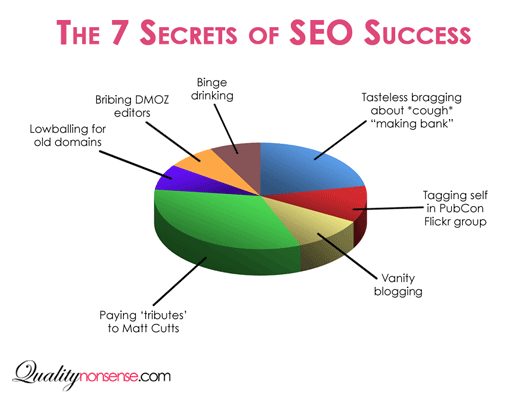
This illustration is from the Quality Nonsense blog.

Great stuff, huh?
Check out the blog, too. This is not True Confessions - more like a Letterman monologue.

You can quickly see the purpose of this illustration from PRomoting Webs site.

The colors are vibrant. The terms used are familiar. But for my purposes -to illustrate the SEO/SEM process, it's only marginally useful.
This could be an introduction of a Powerpoint presentation. Topics are essentially listed in a creative presentation of an outline.
There's no meaningful timeline. 'Strategy' is a slide title; not a step.

This illustration from Bristol Bath Exeter Plymouth Online web E-marketing gets into more depth. But it's so unclear about the presentation an arrow is required to indicate the flow of time.

That's too plain to really catch the eye. In fact, it's a little hard to follow for the uninitiated. There's no question the presenter means business though.

Now, this is a marketing plan! - from ProBlogger right here in Australia.
That's not an illustration. It's an ambitious plan that states goals. It doesn't say much about how those goals will be achieved. Nor does it illustrate recursive steps. This guy wants it all, and NOW!
Combined with a couple of the other illustrations, it could be very effective. To accomplish those goals though, this guy needs to assemble a team. Wonder if he needs an SEO Consultant?

In the light of the introduction of Universal Search, and presuming the quality of illustration will improve, - none of these illustrations is very impressive. In different circumstances -different clients, where the illustration appears, and style of presentation or presenter, all of them could be effective to explain the process.

This illustration from Inventa Technologies is a little too complicated.
'Development' is really a title. My first thought was to animate it like a roulette wheel. Those small arrows in the center are unnecessary. Some of them are even off-center, too. It's a good list of the initial steps for SEM. It's businesslike (which means the colors could be brighter), but where is the starting point?
The arrows between items seem to indicate each item is a benchmark. They're not. Keyword Selection doesn't have to be done before Site Architecture is done. The list is organized more for the developer than SEO.
I can't escape the feeling this illustration needs animation, and maybe some mouseover effects.

I'm going to finish this little exercise with an illustration I like from the Huntas search engine.
Vibrant earth colors dynamically arranged with energetic lettering, the illustration demands attention.
Overlaying circles suggests topics affects others; and a sequence. To emphasize the sequence, small arrows link around the circles. Although details are missing, the sequencing is accurate. You do have to Optimize a web site before you Submit web pages, for example.
It's a distinctive design, yet businesslike. A student of design will tell you those are Southwestern colors, which have become acceptable throughout the world for business. So the designer kept within the expectations of their audience.
The 2-dimensional design illustrates time effectively. The illustration is intuitively clear and could stand on its own. It requires no presenter or additional text to get its point across.

I hope you've enjoyed my review of some of the design efforts to illustrate the SEO/SEM process. Let me know what you think.

PS If representatives of any of the authors or sites wants their illustration removed, feel free to contact me. I'll remove it instantly along with my comments.

SEO/SEM in Australia is a special issue for so many reasons. Join me was we explore. It will be a fascinating and informative journey. Sphere: Related Content

Tuesday, March 25, 2008

Google's Universal Search

This is one I saw coming.
I've been telling clients to get out their webcams and post the video to YouTube to help increase the visibility of their business online. Only a couple of clients took me up on the suggestion. It was hard to overcome the poor Internet connectivity in Australia.

Universal Search
Google's default search will be a Universal Search. The SERPs will include videos, images, news, blogs and web pages. - Everything. It's going to change the SEO/SEM services dramatically.
Universal Search is presently only available in the US. As it spreads across the world, Optimization will include more types of media. The competition for top SERP listings is too competitive to avoid.

You see, really Google is more than a single search engine. In fact, it's many search engines. It's surprising how few people actually use the other search listings. Here's a list:

Each link on the list represents a search engine within Google. Until now, you had to find and use the other search engines. Universal Search, already implemented in the US, will mean all of these search engines will provide SERPs.
If you want just websites and webpages, you'll have to specify that option.

For example, one of the most useful is the Images search. Sometimes, trying to illustrate a website in meaningful ways -something other than pretty girls and other fluff- can be difficult. A quick run through the Images search can give you an idea how others have tackled the problem.
Google News is not comprehensive, but it does provide very recent, relevant information.
For example, I try to stay on top of web developments. I have a weekly email alert on the News search about SEO in Australia.

How will Universal Search affect SEO?
Most websites in Australia are static. The wildfire of SEO services indicates the majority of those sites are not optimized, or even structured. (You gotta wonder what those folks were studying in Web Design classes?)
A few gurus have put out the opinion that for a site to appear high in a Universal Search, the site is going to have to incorporate more universal elements: blogs, images, documents, videos, etc. Naming conventions for these elements will become significant. "img100016.jpg" will be replaced with "black-shoes-look-great.jpg". Because images have their own search engine at Google, it isn't inconceivable that the name of an image could become as significant as a URL.
That presents a problem for a market where business is only beginning to realize the potential of the Web. (Most of my clients are already in the 21st century, I'm happy to say.)

Connectivity still an issue
Some people simply responded: "I can't watch YouTube. Why should I think my customers will?" - And they were right.
Finally, Internet connectivity is improving in Australia. Consumers have become aware of the "Fraudband" -ADSL 256 mbps and below- offerings and ignoring them. Improving does not mean fully implemented. Telstra's rollout of ADSL2 and ADSL2+ is still "aspirational" over the next 9 months. Fraudband is still being sold.
("Aspirational" was Howard's latest way of saying "non-core promises". It's a little like selling opportunity in a multilevel marketing scheme...Howard lost the last election, btw.)

Google may delay the Universal Search rollout for Australia
It may be a good business decision for Google to hold off on providing the Australian market with Universal Search. Large areas of the country, even metropolitan areas, may not have the bandwidth to explore the links.
Google commands nearly 80% of all search traffic in Australia. If a large portion of the Web community cannot click on the SERPs from Universal Search ("USERP"s?), Google could lose its primacy.
The Australian market only represents 1% of the world's Internet population, but it is a rich, competitive and -most importantly- growing market for PPC advertising. Google has only had its regional facilities running for about a year. Yahoo Australia (Yahoo7) offers a much more reliable regional PPC service, and doesn't carry the negative baggage of Google.
The decision for Google will come down to ROI, I imagine. Is the growing Australian market valuable enough not to risk the losses from Universal Search?

Aspirational ADSL
Telstra and other large providers are lowering prices and increasing speeds. Sometimes so quietly you can hardly hear the moss move. Telstra will let customers upgrade to faster speeds free, but the person has to ask for the upgrade. Sometimes the new plan cost less than the fraudband! On the ground, most consumers aren't aware of the situation -yet.
The majority of Australian consumers can now see YouTube videos, use VoIP, and even watch some TV on the Web.
Telstra and Optus are filling TV screens with ads offering a wireless router with ADSL. The "networked home". Great idea. It's been working fine in New Zealand for more than 4 years. Relatively few Australian households enjoy the benefits of a networked home.
(Please forgive the obvious cynicism. It's unavoidable. Australians have been retarded for so long by their government and the large telcos.

A practical run through
Take images as an example. Run a quick search on any topic in Google Images. You'll quickly see that many images were named by software. The name may be from a digital camera, or from the website where the image was purchased.
In the world of Universal Search, that's a missed opportunity. The name of the image may become as powerful an optimization tool as the URL is today. In the Image Search, the name of the image is comparable to the URL of the page; possibly even the page title. It remains to be seen how important to Optimization ALT and TITLE tags will be. Will they be a part of the web page? - or will they be incorporated into the Relevancy calculations for an image?
It's easy to see that ALT tags could become much more important. Those web designers who used the ALT tag to stuff keywords into a document are going have to rethink their (key)words.
Image quality and file size will become more important.
Evenless relevant images will be important for building links. Initially at least, it's not hard to see many sites will fill with images. The practice might come to be called "image bombing", where a site crowds as many images as possible onto its pages to increase its visibility. At least initially, it will improve rankings and conversion rates. How this practice will work out in the long run is yet to be seen.
Hopefully, web designers will press relevant illustrations of business processes; and better product pictures. If not the Web Designers, the SEO people will, I assure you.

Illustrators' Renaissance
Universal Search could drive a renaissance of vector graphics in place of bitmaps. The size of the image file will not just an issue for page download times.
A blotchy image will drive away visitors. Images with good contrast and composition look better in thumbnails appearing next to the link in the search results.

How many web designers have howled into the dark night about having to explain complicated business functions in text, knowing full well that most of the viewers will scan over the page (and never read the well-crafted words)? Good illustrations, animations, and videos that illustrate business processes and services will have a renaissance of sorts. These creative concoctions will have full ranking with web pages and blog articles.

Blogs and Blog articles
Blogs have been the lost hinterland in Australia. Sometimes I think the Outback has a better reputation than blogs.
As it was with Internet access only a few years ago, blog numbers are dominated by large business, national media, universities and TAFEs. Young people are blogging on the social networking sites, of course. Many sites offer free blogging. There are a few blogs set up as ecommerce sites. But few Australians are in the blogosphere.
Citizen journalism here is hindered by restrictive and capricious laws. The concept of slander in Australia is restrictive. It doesn't matter if someone is telling the truth, if the content damages the reputation of the subject, the author is liable for slander.
This is not the United States.

Blogs and blog articles will have to be SEO'd to the same level as web pages under Universal Search. This opens up opportunities for businesses to drive traffic to their websites.
It depends on the editorial policy of the blog, and its goals.
Small and medium sized businesses can demonstrate expertise, build professional reputation, and even have a little fun with blogging. If a blog is too commercial, some blogging sites (e.g., Blogger) will remove access to the blog.
Business blogs can contain anecdotes from Customer service, for example; or outlandish uses for their products; even personal stories about holidays and parties. There is no law that says a business blog has to be all business.
With Universal Search, all these articles will have much more significance.

It's not all that new, really
When you think about it, Universal Search is not a new concept. Google and other search engines have always counted links from YouTube videos, blogs, and their other search engines in the Relevancy calculation. Universal Search is only making that fact obvious.
In doing so, Google is giving those who use the Web community an advantage - and encouraging others to become more community minded. Google is taking a leadership position in defining the relevancy of a website (or blog).
Google's commitment to Relevancy is laudable. My gut reaction is to applaud, in fact. But my head makes me look again at what it may mean to business.

The comments in this article are based on a well-established assumption: That search users will choose from the first 1- 3 or 4-6 of the SERPs. With many new media represented in the SERPs, will that assumption hold true? There will be images, blog articles, and videos mixed in with web pages. Will that cause natural search results to become increasingly irrelevant to business?
If so, will the PPC (Sponsored Links) become far more important and expensive?

Google is taking a leadership role in defining the Web community and Relevance, as it always has. But is Universal Search is a gamble in many ways.

SEO/SEM in Australia is a special issue for so many reasons. Join me was we explore. It will be a fascinating and informative journey. Sphere: Related Content

Thursday, March 20, 2008

Economic Times for SEO

Why does the state of the economy have to do with SEO and SEM? - Everything.
SEO is only the first step towards SEM. Marketers are often compared to guerrilla fighters. "Guerrilla marketing" was a buzzword for marketing online marketing a few years ago.
Mao spoke eloquently and in depth about the role of a guerrilla in society: "The guerrilla in the population is like a fish in a river. If the water is foul, the fish dies. If the water is good for the fish, the fish flourishes."
It's very much the same for marketers. Marketers flourish when the economy is healthy.

Not enough people realize the financial engineering that has created the boom economy in Australia is based on the building industry and real estate market. Most Australians point proudly to the resources boom, but it is just a spike that contributes big numbers. Mining doesn't affect the whole economy anywhere near as much as housing. Mining and resources sales are powerful forces in the regions near the mines.
The resources sector contributes to a healthy balance of payments. One of the indicators of Australia's inflated economy is that the balance of payments is not healthy. The boom has produced an import-driven market where local producers are being priced out of the market. Where is this inflation-driving money coming from?
The long term drought hasn't helped, but market forces could, arguably, have absorbed the drought factor if the import market weren't controlling prices.

Is it a bubble?
The housing boom -government-subsidized building and real estate sales- has created the boom economy. The country has become drunk and addicted to credit. Home ownership is the basis of credit. A home owner can always get a credit card. It's an assumption that homes will always increase in price, and many factors can be quoted to support it.
The family income of the average Australian household is leveraged by credit to 160% (1.6 times the annual income.) That's an average.
On the ground, I know two households who have leveraged their annual income by more than 200% by manipulating credit. Despite all the howling about long hours and job stress, both these couples only worked half a year.
By separating their individual incomes and each working only half a year, they pick up another form of income: government subsidies. One partner applies for broad liberal payments based on their income, easily ignoring the contributions of the other partner. They get even greater leverage by letting the government pay off the credit cards and mortgage.
It's a bubble that has to burst someday. Or does it?
Laberal commentator Ian Martin spelled out the government's attitude before the last federal election. It's an attitude reflected persistently in the press and popular opinion.
There is an Aussie saying: "It's past a joke."
All parties involved seem locked into this scheme, if by nothing else then by the perceptions and attitudes across the country.
There are payments for every stage in life. Most are not means tested. For example, every new mother gets $4000 for giving birth, no matter what the household income.

How does this affect SEO/SEM?
I'll be discussing this issue at length in the next few articles. One factor is that Australia has not experienced a dot-com boom. Most of the country simply didn't have adequate Internet access when the dot-com boom roared through the US, UK, and Europe.
Google wisely only opened offices in Australia two years ago. New amendments to copyright law inordinately influenced by record company activism nearly drove them out in Jan 2007. Google threatened publicly to refuse to index Australian websites. Over 150 exclusions to the law allow a still-tenuous Google presence. Yet Google represents 80% of searches from Australia.
How the changing economic times will affect web design and marketing companies remains to be seen. SEO and SEM may be the means to open the door for Australian small and medium sized business to experience the power of marketing on the Web - to fulfill the lost promise of the web to allow small companies compete in an open market.
The proliferation of SEO companies certainly indicates a need vacuum being filled. It's more a vacuum caused by bad web design and poor access to the Net than an entrepreneurial push though. As online business owners become more savvy, that will change.
I imagine that will be when the SEO companies shake out the chaff, too.

SEO/SEM in Australia is a special issue for so many reasons. Join me was we explore. It will be a fascinating and informative journey. Sphere: Related Content

Sunday, March 16, 2008

Web Design 101 - First Period

I am, by my own admission, a lousy web designer.

Why? - Because I hate templates.

The first website I saw was made by Microsoft's FrontPage 97. All you had to do was tell it: Make me a corporate web! - and FrontPage would dutifully generate homepage, about us, products, and services, and contact pages. Poof! A small company was IBM.
The title of the page was in a box at the top, and all the structural tags - H1, H2, etc. - were colored, sized, and decorated for you. In most templates, it even gave you little graphics for unordered lists.
All you had to do was fill in the blanks, and you were a working company on the Web.
It was a raving bore in 94; and it's only more today. (Not a great poet, either, you'll notice.)

One of the first rules of web design is to make your pages look pretty much the same. The idea is that you won't confuse your visitors, and maybe even establish your corporate or personal style.
That was find in those days if your sense of style is either blue jeans or polyester slacks.
Problem was, that layout implied a company had to have Products and Services. Some companies didn't. That alone created a sense of insecurity or desperation.

Design the information to express

I've never been much of one to put things in little boxes. Design should express and enhance, not restrict.

I tend to want to design a website page by page to reflect the present attitude of the company. If it's a small company that just got a new logo done, then let's let it fill half of space above the fold. Why not? This is company just coming into its own.
They're proud of their new logo. It's all over their vans, new business cards and new company literature. Put it out there for the world to see!
They've only got a few services, but those services are needed in their area. Their customers like them. One of them said so right in the middle of the home page.
Just put a list on the side full of links to get more info.

A design like that gets poo-poo'd a lot. Even customers don't like it because they don't think it looks "business-like". (Not that anyone has ever defined "business-like" too well.) It becomes a matter of latent expectations, not perceiving.

Why does a web page have to follow the pattern of a business letter? Why not let it be a presentation right from the homepage? You got a new company, tell the world about it.
You can always add or adjust stuff later.
It has to look like a business letter because customers won't know what to do. Or, It has to look like a business letter because that's what this site looks like. (The one I'd like to be...)

Wired wonders
Wired proposed over a decade ago that we use the web space better. (I lost track of the article or I'd provide a link.)
Web pages only had to show a window into the content. It's what they do anyway. There could be content spread wide and far across thousands of pixels of space. One click, and the viewport shifted to another part of the grandscape.
They were far ahead of their time.

Web pages in those days were constrained by download speeds on 33k and 56k modems. If a webpage had more than 30K of content - images, programming, and HTML - visitors just went somewhere else.
The download time has changed a little with the spread of broadband, but the size limitation for templates still holds them below 60K. And all of it has to fit on a business letter, within two clicks down the sidebar.

The article proposed broad, bold colors. Wide colored channels guided the visitor across the webscape to explore information or make a purchase. The user actually interacted with the page instead of just clicking away.
Changing colors in the viewscape indicated where the visitor was in the process. All the information was contained on the page, so there was no need for flickering screens. The body tag encompassed many pages, really viewports, of the viewscape. If the visitor wanted, they could ramble around without following the colored guide lanes - and take the path less followed.
Using a mouse or the arrow keys, they could go anywhere just like exploring a landscape on Google Earth. Zoom in or out to get their bearings, then off to explore again.
I don't imagine such a site would have a problem with stickiness...

Where does all of this fit into SEO and SEM? That's going to be a topic or two for another time.

The plan in those days long ago was to use Javascript and Java to implement responsiveness and new content on demand. That can still be done, of course, but there are much more exciting options now. (continued later)

SEO/SEM in Australia is a special issue for so many reasons. Join me was we explore. It will be a fascinating and informative journey. Sphere: Related Content

Sunday, February 24, 2008

Blogger's (Google's really) Link Widget

I have been remiss. This blog hasn't had the attention it deserves for too long.
In an effort to try to make up for this sad state, I decided to pull up the Blogger Layout and add some of the blogs and websites I read and use for insight, information and perspective. Not just in Australia, but around the world, there are at least 50 or so.
Happily tracking back through the Bookmarks on three browsers, Bloglines feeds, and the saved links on Google docs, .. It was getting a little tiring even for Sunday afternoon busy work.

Then I noticed something.
I'd set the number of links to show to 8. The whole list was approaching 50 or so, and more to come, so I decided it was time to save my work and see what the blog looked like. Sure enough, only 8 were listed.
Considering the importance of inbound links in the Google eye, how does that work?
Do all the links count? They are listed, after all. Or does Gooogle only count those listed links? Are invisible links still a measure of relevance?
This deserves a little more research. I'll have to send an email to my friends at Blogger and see what they have to say.
Stay tuned.

SEO/SEM in Australia is a special issue for so many reasons. Join me was we explore. It will be a fascinating and informative journey. Sphere: Related Content