Showing posts with label blogging. Show all posts

Sunday, April 6, 2008

One Keyword per Page

A license plate seen in the Googleplex parking lot.Image from WikipediaSearch Engine Herald ran an article by Noel titled "SEO Basic - One Keyword per Page" which stuck in my mind for a bit, so I posted the following comment:

What do you mean by ‘optimizing’ when you say one keyword per page?
The LSI process tracks the use of associated terms to interpret the subject of a page. If you define ‘optimization’ as terms within the 2%-15% keyword density (some people target 5%-12%), then the goal of optimization would be to get as many of the commonly associated terms into that range - not just one keyword.
Whichever range is used, getting just one keyword (or phrase) into that range dictates some very short pages. Google once looked at only the first 250-500 words of content in order to build up their index quickly, that’s true. That was a few years ago.

The result was many SEO people writing a lot of short pages that resembled intrusive advertising as opposed to truly relevant information.

But Google has changed its perspective recently to favor pages with around 1000-1200 words, which arguably allows for more pertinent information.
Many business websites find it difficult to find 500 words about a category or product, much less 1000, which reflects Google’s long-standing policy to return SERPs which favor information as opposed to sales pitches.

The article is on SEO basics. My comments took the subject matter a little further. I just didn't think this short article was being very clear, that's all.
I'd just finished a keyword density analysis on a homepage. There was one word on the page that was within the indicated range. I'd rewritten the page to have 17 words and phrases within the 2-15% range. All but one of the terms clearly pertinent to the topic and the goals of the homepage.

Homepages can be difficult for SEO.
A company may provide a number of services and products that need to be presented along with a brief introduction to convey the attitude and quality of the business.
The Value Proposition of the business is often expressed in a slogan that is not commonly associated with the type of business.
The wider the distribution of services and products, the more the keyword density will be diluted. This is the challenge of SEO and web design.

It's much easier to get the right mix of keyword density for a page on a category of services and/or products; or for a particular service or product. Although finding 250+ words to say about some products can be difficult too.

LSI can actually make writing relevant pages easier, too.
A little research can reveal a number of associated terms on most topics, which means the text can flow more easily and include greater detail without losing relevancy. In fact, using the right combination of terms can make the page more human-readable and more relevant.
Complexity isn't always a negative. Humans are complex. I suppose it could be said the complexity of content has to match as closely as possible the complexity of the target audience.

The complexity offered by LSI and longer pages poses the challenge of writing content that is still scannable. Web users still scan the page. Very few read more than about 55 words or so.
Visitors can be induced to read more of the content by good presentation and interactive content, but that has its limits. A great deal depends on assumptions about the type of traffic the site will draw, and the marketing goals.

Australia
Is it fair to tell a DYI web designer to try to target only one keyword or key phrase per page?
Part of the answer depends on the locale. The article referenced above was written for the US market, where competition is fierce. Content designers in the US market have to contend with a more balanced apportioning of the search engine market.
In Australia, Google with LSI still controls 80% of the search traffic. That's really the basics in this market.
Australian web designers must write for the cutting edge technology, or seek traffic elsewhere. Most Australian sites are designed to be marketed within Australia and New Zealand.; if not regionally within Australia.

SEO/SEM in Australia is a special issue for so many reasons. Join me was we explore. It will be a fascinating and informative journey.
Sphere: Related Content

Wednesday, March 26, 2008

SEO Illustrations

After piecing together the post on Universal Search, I decided to take my own advice to see how others had illustrated the SEO/SEM process. It's harder than you think to illustrate a 3-dimensional, really 4-dimensional, process for those who are not at least somewhat familiar with how the dynamic mechanisms of the Web works. I hope these guys don't mind a little link love.
Here is the one that caught my eye first.

The illustration is from RedalKemi.com
That's really not a bad. You can take a look at it if you like. I'm just studying how the process is illustrated.
The diagram clearly illustrates the benchmarks. (Benchmarks is a project management term for issues that must be resolved before continuing with the project.) Time is implied from top to bottom.
There are a few unclear elements. CORE is a neologism from the marketing department. The initials LB and AS stand for Link Building and Automated Submissions, respectively. The website explains the terms and process in some depth, although for clarity the image could be made into a link map. There could be some confusion over whether AS stood for AdSense or Automated Submissions, for example.

This illustration is from the Center for Citizen Media blog.
Obviously, not everyone approves of SEO. I'm not sure which step the author disagrees with most: overaggressive marketers gaming the system or Google closing the loopholes and dinging the sites that break Google's rules.
It can be argued successfully (I can show a couple of examples offhand.) that marketers are creating better content and more timely content. The support for Google comes down almost to prejudice and politics. Will consumers revolt because content is more relevant (more informative and timely)? Is any of this destroying the Web? If you think of the Web as a young mind, then Google's Relevancy efforts are the way a child matures by learning and testing rules.
The philosophical and political arguments can go on and on.

As a marketing tool, this illustration from the Before Your Interview blog is great. Although it appears to be 2-dimensional, it's really linear; more correctly, circular.

It's intuitive and easy, and allows the presenter to discuss many issues in the process. It's attractive. The bright colored arrows catch the eye. The use of whitespace is good.
Despite the large numbered steps, it's a little unclear where to start. And where to finish. In a way, it deceives the intuition a little. There is less of an attempt to illustrate the details of the process than to allow the presenter and client to discuss the steps.

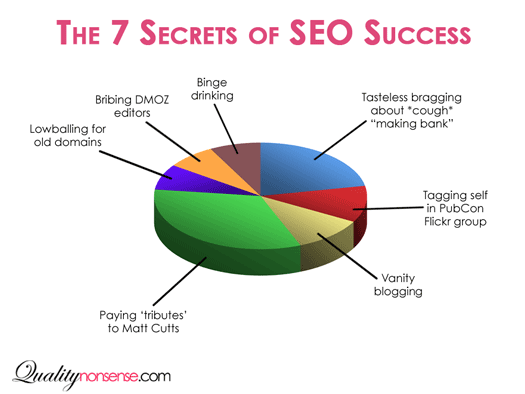
This illustration is from the Quality Nonsense blog.

Great stuff, huh?
Check out the blog, too. This is not True Confessions - more like a Letterman monologue.

You can quickly see the purpose of this illustration from PRomoting Webs site.

The colors are vibrant. The terms used are familiar. But for my purposes -to illustrate the SEO/SEM process, it's only marginally useful.
This could be an introduction of a Powerpoint presentation. Topics are essentially listed in a creative presentation of an outline.
There's no meaningful timeline. 'Strategy' is a slide title; not a step.

This illustration from Bristol Bath Exeter Plymouth Online web E-marketing gets into more depth. But it's so unclear about the presentation an arrow is required to indicate the flow of time.

That's too plain to really catch the eye. In fact, it's a little hard to follow for the uninitiated. There's no question the presenter means business though.

Now, this is a marketing plan! - from ProBlogger right here in Australia.
That's not an illustration. It's an ambitious plan that states goals. It doesn't say much about how those goals will be achieved. Nor does it illustrate recursive steps. This guy wants it all, and NOW!
Combined with a couple of the other illustrations, it could be very effective. To accomplish those goals though, this guy needs to assemble a team. Wonder if he needs an SEO Consultant?

In the light of the introduction of Universal Search, and presuming the quality of illustration will improve, - none of these illustrations is very impressive. In different circumstances -different clients, where the illustration appears, and style of presentation or presenter, all of them could be effective to explain the process.

This illustration from Inventa Technologies is a little too complicated.
'Development' is really a title. My first thought was to animate it like a roulette wheel. Those small arrows in the center are unnecessary. Some of them are even off-center, too. It's a good list of the initial steps for SEM. It's businesslike (which means the colors could be brighter), but where is the starting point?
The arrows between items seem to indicate each item is a benchmark. They're not. Keyword Selection doesn't have to be done before Site Architecture is done. The list is organized more for the developer than SEO.
I can't escape the feeling this illustration needs animation, and maybe some mouseover effects.

I'm going to finish this little exercise with an illustration I like from the Huntas search engine.
Vibrant earth colors dynamically arranged with energetic lettering, the illustration demands attention.
Overlaying circles suggests topics affects others; and a sequence. To emphasize the sequence, small arrows link around the circles. Although details are missing, the sequencing is accurate. You do have to Optimize a web site before you Submit web pages, for example.
It's a distinctive design, yet businesslike. A student of design will tell you those are Southwestern colors, which have become acceptable throughout the world for business. So the designer kept within the expectations of their audience.
The 2-dimensional design illustrates time effectively. The illustration is intuitively clear and could stand on its own. It requires no presenter or additional text to get its point across.

I hope you've enjoyed my review of some of the design efforts to illustrate the SEO/SEM process. Let me know what you think.

PS If representatives of any of the authors or sites wants their illustration removed, feel free to contact me. I'll remove it instantly along with my comments.

SEO/SEM in Australia is a special issue for so many reasons. Join me was we explore. It will be a fascinating and informative journey. Sphere: Related Content

Sunday, September 9, 2007

Australian IT: Bad Form

Sometimes playing with research tools is a little sobering.
I love a good cynical laugh, especially at the expense of some ignoramus in the law around Australia more than most, but this article from AustralianIT is just headline grabbing nonsense. Most of the article has nothing to do with the headline, "Judge says Keep IT simple, stupid". The rest of the article is just loose change about a new MySpace for dogs, Florida electoral machinery, and other fluff.

The excerpt about the judge is taken (supposedly) taken from Annova. Yet there is no link. Annova functions in Australia as a distributor and an eBay store. They are an electronics retailer from the UK.
The story did the rounds in the UK and then got picked up by The Australian and even an aussie student's forum post.
The student's forum post and the AustralianIT story have an important point in common: Neither indicates that this is a UK judge. What is sad to find is this man is also a very learned QC who even writes regularly for medical journals. For a man who doesn't know what a website is, his career is all over the Internet.

This sort of loose journalistic effort only feeds the fires of those who see the Internet as the enemy. And I resent this sort of thing even more coming from AustralianIT, which has been an important resource for me to learn about IT and the Internet in Australia.

Now this is from Annova, picked up by TimmyB on Oreilly, and it is wryly funny.

Just a raw plug for my first SEO clients:
Short Cut Computers belongs to Steve Trim, a friend who actually paid me to learn this stuff and put it to work for him.
And Steve Trim's other business, Barcode Solutions., which will be my second project. Sphere: Related Content

Telstra takes to the mattresses (or blogs)

Telstra has drecided to join the rest of the blogging world. In the usual Telstra style, the new blogs are professional looking and full of user-unfriendly bugs. A massive array of corporate blogs, all carefully edited to put the company's best foot forward.
Too bad the company's policies prevent most of the country from joining the free world.

Buggy
Most of my customers are small businesses. SME's (Small- to Medium-sized Enterprises to the rest of the world); "small business" to the ATO. Considering that these businesses employ 85% of the workforce and are 96.4% of the registered businesses in Australia, I was particularly dismayed to find the new 'Small Business' blogger was the former soppy 'Lifestyles' blogger.
She goes on and on about her fascination of the insects she calls 'nerds', but the nerds at Telstra have their revenge: neither the RSS feed nor the Comments on her blog work. (She may not want the Comments to work.)
You can almost hear the gnomes chuckling.

You have to read the news like a conversation.
When the person blogging about small business in Australia keeps citing studies done by large retailers in the US; and calling Internet entrepreneurs "nerds", it's not hard to conclude she wishes she lived somewhere else. (Hint: She certainly needs to work somewhere else...)
One thing is certain: She has little or no idea what it means to develop the Internet as a resource for a small business in Australia.

Her first article was for 'Breast Cancer Day' at the Telstra Dome. Laudable, but hardly 'News you can use'. (A leftover from her former project?) She is far out of touch with the needs of small business in Australia.

A few of the other blogs have undefined RSS feeds, too. And Telstra wonders why it's losing money? I did find a useable feed on the homepage.

Comments
There are 4 separate blogs complaining about the regulatory requirement to keep CDMA in place until the NextG network is running properly. The blogs are full of people complaining about holes in service. The chief technical blogger advises getting a magnetic antenna; and one comment says it will make a nice paperweight.
No one dares complain about the fees. (I guess they leave that to the Dodo ad.)
Telstra whinges on to make its case. All Telstra has to do is explain that they want to cripple their competitors and are willing to leave 1/2 the population without reliable broadband.
Strangely, most of the Comments on these blogs seem to be Telstra shareholders. The shareholders want to know why Telstra shouldn't be allowed to make the same obscene profits as steel companies.

CDMA divine
Optus, iiNet, and other carriers in the G9 consortium built their business by sharing Telstra's CDMA network. This was mandated by regulations in order to introduce competition into the market. Only 10 years ago, Telstra was a monopoly. The only game in town.
When Telstra dragged its feet (for 7 years overcharging consumers for piss-poor broadband) on the issue of fibre cabling and then wireless internet access, 9 of these companies formed a consortium, excluding Telstra, and filed a competing proposal to do the work.
Here would be a chance for Telstra to let them know why they shouldn't mess with the Mother Country (..or Mother Nature, or God, etc.)
CDMA will go sooner or later. Telstra probably intended to handle the changeover as they did ADSL: charge heavily for the NextG service as it was grudgingly enabled. This is one case where the politicians should be applauded.

When you read these blogs as a conversation along with the other blogs on these topics, the Telstra gang seems to want to dominate the discussion to put the party line forward. The internet marketing of these blogs seem to be towards Telstra shareholders and employees, too, which skews the tone of the response.
I suppose all's fair in love and war, or business, but as an interested observer, you do get tired of seeing people ground up in the conflict.
Until broadband improves to the point small business can see the efficacy of the Internet, SEO and SEM will only be valuable tools for the privileged few.

Notes:
CDMA -- (Code Division Multiple Access): A technology for digital transmission of radio signals between, for example, a mobile telephone and a radio base station. In CDMA, a frequency is divided into a number of codes. A spread spectrum approach to digital transmission. With CDMA, each conversation is digitized and then tagged with a code. Also known as IS-95A or cdmaOne

Just a raw plug for my first SEO clients:
Short Cut Computers belongs to Steve Trim, a friend who actually paid me to learn this stuff and put it to work for him.
And Steve Trim's other business, Barcode Solutions., which will be my second project.
Sphere: Related Content